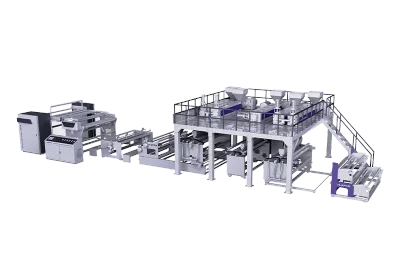
7-Layer High-Speed Bubble Film Machine Equipment Advantages
2026-09-02
Bubble film is widely used for protective packaging in manufacturing, e-commerce, warehousing, and international logistics. Its air-filled structure provides cushioning for electronics, glassware, ceramics, industrial components, and other products during handling and transportation. As packaging manufacturers face rising resin costs, stricter quality requirements, and growing pressure to reduce energy consumption, conventional bubble film production systems are facing increasing limitations.
Our modern 7-layer high-speed bubble film extrusion machine provides a more flexible production solution. By distributing different materials across multiple layers, improving process control, and optimizing heating efficiency, the equipment can help manufacturers achieve more consistent bubble film quality while improving material utilization and controlling operating costs.
Challenges Facing Conventional Bubble Film Production
Limited Material Flexibility and Cost Control
Simpler extrusion structures provide fewer opportunities to distribute different materials according to their functions. When manufacturers introduce recycled polyethylene, lower-cost resin, or functional additives, maintaining the required appearance, strength, and cushioning performance can become more difficult.
A multi-layer structure provides greater formulation flexibility. Recycled material can be concentrated in selected internal layers, while outer layers can be optimized for surface appearance and required performance. This helps manufacturers balance material cost and bubble film quality more effectively.
Inconsistent Thickness and Bubble Formation
Bubble film production requires stable melt temperature, extrusion output, cooling, bubble forming, and winding conditions. Variations in these parameters can lead to uneven bubble film thickness, unstable bubble geometry, or flat-bubble defects.
These problems become more significant at higher production speeds. For electronics, precision equipment, and fragile products, inconsistent bubble film quality can affect cushioning performance and increase production scrap.
High Heating Energy Consumption
Extrusion is a continuous thermal process, making heating efficiency an important factor in production costs. Conventional heating configurations may require longer warm-up periods and experience greater heat loss from the extrusion barrel.
For manufacturers operating long production cycles, improving thermal efficiency can reduce energy consumption while shortening startup preparation time.
Why Bubble Film Matters Across Industries
Different packaging applications place different requirements on bubble film. Electronics and precision instruments need reliable cushioning to reduce the effects of impact and vibration during transportation. Glassware, ceramics, and other fragile products require consistent air-cell structures for additional protection during domestic and export logistics.
E-commerce packaging creates another high-volume application. Frequent picking, packing, and shipping require large quantities of consistent bubble film with efficient production. Automotive and industrial component manufacturers may also require different thicknesses, cushioning levels, and material structures for different products.
Flexible Material Structures for Better Cost Control
A key advantage of a seven-layer configuration is the ability to assign different functions to different layers. Instead of using one material formulation throughout the entire bubble film structure, manufacturers can optimize each layer according to its role.
Depending on recycled resin quality, processing conditions, and the target bubble film specification, selected inner layers can incorporate recycled content at ratios of up to 50%. This approach can increase recycled material utilization while allowing the outer layers to maintain the required appearance and performance.
The same principle applies to functional additives. Higher-cost additives can be concentrated in specific layers where their function is most valuable rather than being distributed throughout the complete bubble film structure.
For high-volume packaging converters and e-commerce packaging suppliers, this flexibility can provide more options for controlling resin costs while developing bubble film products for different customer requirements.

PLC Control for Consistent Bubble Film Quality
Process stability is critical for high-speed bubble film production. A PLC-based control system can coordinate key parameters such as extrusion temperature, screw speed, cooling conditions, traction, and winding tension.
Multiple independent temperature zones allow operators to manage thermal conditions more precisely across the extrusion section. Depending on the configuration, a seven-layer bubble film extrusion machine can use around 30 or more temperature control zones across the extrusion and processing sections.
Under defined production conditions and with suitable raw materials, bubble film thickness can be controlled within approximately ±3%. Stable extrusion and forming conditions can also reduce flat-bubble defects and improve bubble uniformity.
Energy-Efficient Heating for Lower Operating Costs
Heating efficiency has a direct influence on the operating cost of continuous extrusion equipment. Our seven-layer bubble film extrusion machine can combine infrared heating with insulated extrusion barrels to improve heat utilization and reduce thermal losses.
Under comparable operating conditions, this configuration can reduce heating-related energy consumption by more than 25% compared with conventional heating arrangements. Actual savings depend on resin type, production speed, bubble film specification, ambient conditions, and operating practices.
Improved heat transfer can also shorten warm-up time and help the equipment reach stable processing conditions more quickly. For factories operating multiple shifts, reduced startup time can contribute to better equipment utilization and lower production downtime.
More stable thermal management can also support consistent melt conditions during continuous bubble film production. For large-volume manufacturers, this provides a practical way to improve energy efficiency without focusing only on production speed.
A More Flexible Approach to Bubble Film Production
A seven-layer structure is not simply about adding more layers. Its value comes from providing greater control over material distribution, film performance, and production conditions.
Multi-layer co-extrusion allows manufacturers to optimize material usage and introduce recycled content into selected layers. PLC-based automation and multi-zone temperature control help maintain more consistent production conditions, while infrared heating and insulated extrusion components improve thermal efficiency.
For manufacturers serving e-commerce, electronics, fragile goods, automotive, and industrial packaging markets, these capabilities translate into a more balanced approach to material utilization, film quality, and operating costs — which is exactly the outcome our 7-layer high-speed bubble film machine is engineered to deliver.
By bringing together flexible multi-layer co-extrusion, tight process control, and energy-efficient heating in a single production line, our equipment gives manufacturers a practical path to upgrading their bubble film capabilities — supporting stable output across a wider range of applications while helping lower long-term production costs. For manufacturers ready to move beyond the limitations of lower-layer systems, this is the kind of equipment built to grow with that demand.