
Component Introduction
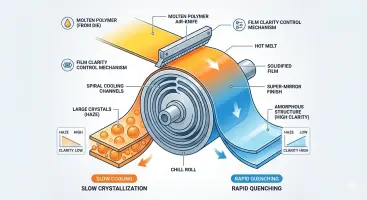
How Stretch Film Making Machine Chill Roll Design Affects Film Clarity
Explore how mirror-polished chill rolls, precise temperature control, and enhanced cooling channels in cast extrusion lines reduce haze, boost transparency, and deliver superior surface quality. This technical insight helps manufacturers select the right 2-layer, 3-layer, 5-layer, semi-automatic, or fully automatic stretch film machine for high-clarity production.
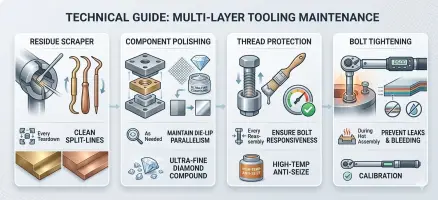
How to Clean and Maintain a T-Die for Stretch Film Making Machine
Proper T-die cleaning is vital for stretch film thickness uniformity and surface quality. This guide covers hot disassembly, brass tools, lip polishing, and torque calibration to minimize defects and downtime.
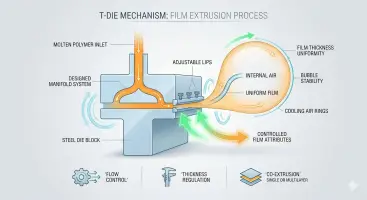
Decoding the T-Die Mechanism in Bubble Film Making Machine
The T-die in bubble film extrusion controls molten polymer flow, ensuring uniform film thickness and bubble formation. Its adjustable lips, combined with precise temperature and pressure regulation, prevent gauge variations and defects. Optimized T-die design enhances bubble stability, mechanical strength, and co-extrusion efficiency in single- or multilayer film production.
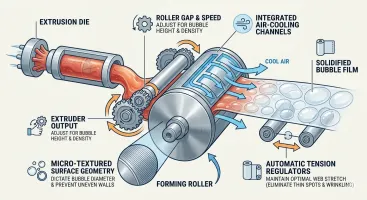
The Role of Forming Roller in Bubble Film Making Machine Explained
In bubble film production, the forming roller shapes and stabilizes molten polymer into uniform bubbles. By precisely controlling bubble size, thickness, and surface tension, it ensures consistent film quality. Combined with air cooling and tension regulation, the forming roller is critical for efficient, defect-free bubble film production...
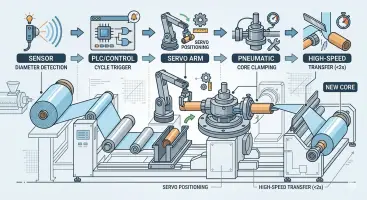
Automatic Core Changer for Stretch Film Making Machine: How It Works
The Automatic Core Changer revolutionizes stretch film production by replacing cores without stopping the line. Integrating sensors, pneumatic actuators, and servo-driven mechanisms, it eliminates downtime, maintains consistent tension, and enhances safety. This technology is critical for 2-layer, 3-layer, and 5-layer stretch film machines, delivering unmatched production efficiency and profitability.
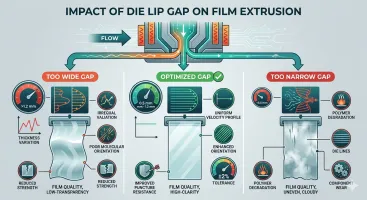
The Impact of Die Lip Gap on Stretch Film Quality
Die lip gap critically influences stretch film properties. Precise control affects film thickness, uniformity, and mechanical performance. Excessive gaps cause gauge variation and reduced tensile strength...
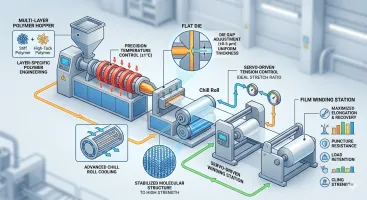
The Core Role of PLC Control Systems in Stretch Film Manufacturing Machine
PLC systems act as the central intelligence of stretch film manufacturing machines, ensuring high-precision automation through real-time monitoring. By regulating extruder temperatures, synchronizing motor speeds, and mana
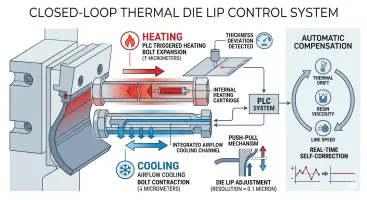
Principles of Thermal Expansion Bolts in Automatic Die Heads
In the high-stakes world of B2B industrial film production, even micron-level inconsistencies in die gaps can lead to catastrophic material waste and downtime. Traditional manual die adjustment methods are slow, inaccurate, and rely heavily on operator expertise. Our patented Thermal Expansion Bolt (TEB) technology revolutionizes automatic die heads for 2-layer high-speed bubble film machines, 7-layer high-speed bubble film lines, and 3-5 layer medium-speed film extruders. By integrating internal heating cartridges and forced-air cooling, these actuators induce precise longitudinal elongation, dynamically regulating die lip openings with closed-loop feedback. This automated system eliminates manual tuning, delivering uniform film thickness across entire production runs. The result: a 15-20% reduction in material waste, faster start-up cycles, and consistent product quality that exceeds global packaging standards. For procurement managers evaluating 2-layer stretch film machines or 5-layer high-speed bubble film lines, this technology offers a clear competitive advantage in operational efficiency and total cost of ownership...
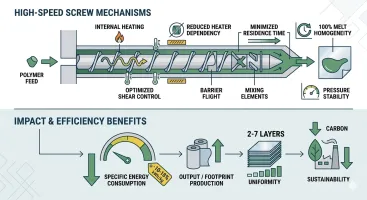
How High-Speed Screw Design Boosts Energy-Efficient Output?
High-speed screw design optimizes energy efficiency by maximizing shear heating to melt polymers, reducing reliance on external heater bands. This s
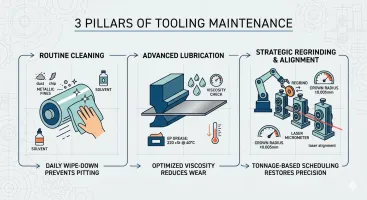
A Comprehensive Guide to Roll Forming Tooling Maintenance and Care
This comprehensive guide explores essential protocols for roll forming tooling maintenance, emphasizing routine cleaning, precise lubrication, and strategic regrinding to extend service life. By addressing surface wear and alignment, manufacturers can ensure consistent profile accuracy, minimize production downtime, and optimize the longevity of critical forming components in high-volume metal fabrication...