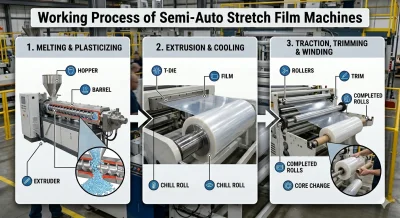
Working Process of a Semi-Auto Stretch Film Extrusion Machine
2026-09-04
A production line is only as useful as its ability to match how orders actually arrive. Fully automated systems excel at long, unchanging runs, but many stretch film producers deal with the opposite reality — a steady stream of different widths, core sizes, and order volumes that shift from week to week. A semi-auto stretch film extrusion machine is built specifically for that reality, pairing fully automated extrusion, cooling, and tension control with a manually assisted winding station that keeps day-to-day production flexible without adding unnecessary mechanical complexity.
Seeing how the process comes together from resin to finished roll makes it clear why this configuration has become a practical choice for producers who need to balance consistent film quality against the realities of variable order volume and tight maintenance budgets.
Common Challenges in Stretch Film Extrusion and Winding Systems
Fully automated winding systems look impressive on paper, but they come with a real cost in complexity. Robotic arms, multiple sensors, and layered automation logic mean that when something breaks, repairs take longer and replacement parts cost more — a burden that smaller and mid-sized production operations often cannot absorb without significant downtime. That complexity becomes even more of a liability when order profiles change often, since switching between different film widths and paper core diameters on a heavily automated winder tends to require lengthy changeover procedures that eat directly into production time.
Upstream of the winder, plasticization consistency is its own recurring problem. Extruders without precise temperature control struggle to fully plasticize resin and maintain a stable melt flow, and any inconsistency here shows up later as uneven mechanical strength across a roll. Material waste compounds the issue. Without an integrated trim-recovery system, edge trims from casting and slitting have to be collected manually and processed offline, which lowers material utilization and adds an extra labor step to every production run. Tension control rounds out the list of common weak points — when winding tension is not tightly regulated, rolls come out with loose winding density or uneven edges, and that inconsistency often turns into film deformation once the rolls sit in storage or travel through a supply chain.
Why Flexibility Matters as Much as Output
These problems are not evenly distributed across the industry — they concentrate in specific operating conditions. Contract packaging operations that handle small-batch, highly customized orders feel the changeover penalty most acutely, since frequent shifts in film width and core diameter mean a rigid, fully automated winder spends as much time being reconfigured as it does actually producing film. Regional logistics and repackaging businesses face a related but distinct challenge: their production volumes are steady but moderate, which makes a high-end fully automated line difficult to justify on return-on-investment grounds, even though they still need dependable film strength and clean roll geometry. Industrial packaging applications, such as wrapping building materials or hardware components, add another layer of demand, since irregular order patterns require a machine that can deliver both stable output and quick adjustment without a long learning curve for operators.

From Resin to Finished Roll: How the Process Comes Together
Production starts with LLDPE resin fed into extruders with precise, independently controlled temperature zones. Complete plastication and a stable melt flow at this stage are foundational — any shortfall here carries through to inconsistent mechanical strength in the finished film, which is why melt stability is treated as a starting requirement rather than an afterthought.
From there, the molten polymer passes through a high-precision T-die and onto a large-diameter chill roll. This rapid quenching step solidifies the film almost instantly, locking in molecular orientation while it is still forming. That instant solidification is what allows the finished film to achieve strong optical clarity alongside a consistent gauge thickness, rather than trading one for the other.
Once the film has been cast and cooled, it moves through automated traction and precision edge trimming. An integrated online recycling system grinds the trimmed edge material and feeds it directly back into the extruder, which keeps material waste close to zero and reduces the cost of raw material per finished roll — a meaningful advantage for operations where margins depend on minimizing scrap.
The winding stage is where this configuration distinguishes itself. Extrusion, cooling, and tension control all run fully automatically, but the winding station itself is designed for manually assisted roll changes. This semi-automatic approach simplifies the mechanical structure at exactly the point in the line where complexity tends to cause the most downtime, which keeps maintenance straightforward while still supporting a steady, high-volume production rhythm.
Technical Advantages That Translate Into Real Production Value
Operational flexibility stands out as the clearest benefit of this design. Because the winding interface is manually assisted rather than fully robotic, switching between different film widths and paper core diameters happens quickly, which makes the machine particularly well suited to customized or short-run orders where a fully automated winder would otherwise slow production down with lengthy changeover cycles.
Reliability follows closely behind. With fewer complex robotic components in the winding section, the machine holds up well under continuous use, and when maintenance is needed, it tends to be simple and fast rather than requiring specialized technicians or long parts lead times — a combination that keeps uptime high and supports a stronger return on investment over the life of the equipment.
Film quality benefits directly from the automated portion of the line. Precise tension control keeps roll edges flat and winding density consistent from the first wrap to the last, which prevents the kind of deformation that can develop when film sits in a warehouse or moves through multiple handling points before reaching its final destination.
Material efficiency closes the loop. Advanced extrusion control minimizes gauge variation across the web, which reduces film breakage during winding and downstream use while making more efficient use of raw resin — a benefit that compounds with the online edge-trim recycling system already built into the line.
Built for Producers Who Need Both Flexibility and Quality
A stretch film extrusion machine designed around a semi-automatic winding interface gives producers a genuinely practical middle ground: the melt stability, precision casting, rapid quenching, and automated trim recovery of a fully engineered extrusion system, paired with a winding station that stays simple to operate, quick to reconfigure, and inexpensive to maintain. Our semi-automatic stretch film extrusion machines are built around exactly this balance, with precisely temperature-controlled extruders, high-precision T-die casting, large-diameter chill roll quenching, and integrated online edge-trim recycling working together upstream of a winding station designed for fast width and core changes. For contract packagers handling varied order sizes, regional operations balancing output against budget, and industrial packaging lines that need dependable film strength without unnecessary automation overhead, our machines deliver consistent film quality, low material waste, and the flexibility to adapt production on short notice — without the maintenance burden that comes with fully automated systems.