How Modular Design Shortens Installation Cycles for Stretch Film Extrusion Machine
2026-05-13
Traditional on-site assembly of a stretch film extrusion machine often serves as a significant production bottleneck, extending installation cycles beyond four weeks. An advanced stretch film extrusion machine directly eliminates this industry challenge by fully integrating the high-efficiency advantages of modular design.
By completely pre-assembling and thoroughly testing critical subsystems at the factory, this advanced machinery enables immediate parallel installation on the production floor. This allows engineering teams to position and connect multiple primary units simultaneously rather than waiting for sequential, step-by-step setup.
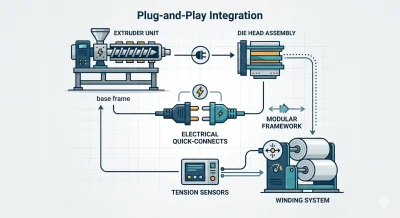
Plug-and-Play Integration
Modular architecture replaces intensive on-site calibration with standardized interfaces:
- Extruder Unit: Pre-aligned and mounted on robust base frames.
- Die Head Assembly: Factory-calibrated for precise layer distribution.
- Winding System: Integrated with pre-wired tension control sensors.
- Electrical Quick-Connects: Heavy-duty plug-and-play connectors eliminate manual wire splicing.
Multi-Layer Configuration Flexibility
This structural framework applies uniformly across various machine specifications. Whether configuring a 2-layer, 3-layer, or high-capacity 5-layer stretch film extrusion machine, the standardized mechanical interconnects remain identical. Every pre-tested subassembly arrives pre-calibrated to maintain exact film gauge specifications and uniform thickness control from the initial startup.
Quantifiable Efficiency Gains
Transitioning to a modular stretch film extrusion machine delivers measurable deployment advantages:
- Time Reduction: Lowers total installation and commissioning time to under 10 days, compared to the industry standard of 25 to 30 days.
- Precision Assurance: Factory-calibrated components eliminate human error during on-site mechanical alignment.
- Resource Optimization: Streamlines the deployment process with fewer required technicians and minimal specialized tooling.
- From fully automatic to semi-automatic configurations, modular design accelerates the transition from delivery to stable, high-speed film production.