Air Pressure Control in Bubble Film Production
2026-09-02
Air pressure stability is one of the most overlooked variables in bubble film production, yet it has a direct impact on how well a bubble film extrusion machine performs under real manufacturing conditions. Even small pressure fluctuations during the forming stage can distort bubble shape, weaken wall thickness, and lead to inconsistent cushioning performance. As bubble film manufacturers face growing pressure to deliver higher output without sacrificing quality, precise air pressure control has become a defining factor separating reliable production lines from those prone to constant troubleshooting.
Where Traditional Bubble Film Equipment Falls Short
Many bubble film production problems can be traced back to unstable forming air pressure. When pressure varies even slightly during the process, bubble walls form unevenly, some bubbles collapse before they set, and the finished film may show visible wrinkles or flat spots. On a bubble film extrusion machine running at high speed, these defects compound quickly, driving up scrap rates and forcing operators to slow down production just to maintain acceptable quality.
The challenge becomes more complex on multi-layer systems. When several melt layers must form and bond simultaneously, each layer needs to be produced under carefully matched conditions. Without independent control over pressure across layers, synchronization problems are common — layers may bond unevenly, weakening the film's structural integrity and reducing its ability to protect packaged goods during transport.
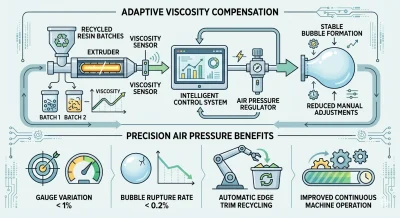
Recycled material adds another layer of difficulty. Recycled resin batches often carry variations in viscosity and flow behavior compared to virgin material. On equipment without adaptive pressure control, these variations translate into inconsistent bubble formation, requiring frequent manual adjustment and limiting how much recycled content a manufacturer can realistically use.
Why Bubble Film Remains Essential Across Industries
Despite these production challenges, demand for high-quality bubble film continues to grow. E-commerce fulfillment centers rely on it to protect a wide range of products moving through high-volume shipping networks. Electronics and precision instrument manufacturers depend on it to prevent shock and vibration damage during transit. Fragile goods such as glassware and ceramics require consistent cushioning to survive long-distance shipping, while automotive and industrial parts manufacturers use heavier-duty bubble film to protect components with sharp edges or significant weight.
Across all of these applications, the underlying requirement is the same: bubble film needs to pe rform consistently, batch after batch. A single weak spot or collapsed bubble can be the difference between a product arriving intact and a costly damage claim. This is exactly why the equipment producing the film — and specifically how well it controls forming air pressure — matters so much to manufacturers further down the supply chain.
How Precision Air Pressure Control Solves These Problems
Modern bubble film production addresses these challenges through closed-loop air pressure control. A PLC-based system continuously monitors pressure during the forming process and makes real-time adjustments to keep conditions stable, rather than relying on fixed settings that drift as production continues. This kind of responsive control keeps bubble formation consistent from the start of a production run to the end, reducing the gradual quality decline that often affects less sophisticated equipment.
On a bubble film extrusion machine equipped with multi-zone pressure management, each functional layer can be produced under its own optimized conditions. A softer inner cushioning layer and a more rigid outer protective layer can form simultaneously without one affecting the stability of the other. This is particularly valuable for multi-layer film, where uniform bubble shape and strong interlayer bonding directly determine how well the finished product performs as protective packaging.
Independent pressure zones also make it possible to synchronize multiple extruders more precisely during multi-layer co-extrusion. Rather than treating the entire system as a single pressure environment, each layer is stabilized individually, resulting in stronger bonding between layers and more predictable bubble geometry across the width of the film.
Adaptive pressure control brings additional value when recycled materials are part of the formulation. As resin viscosity shifts from batch to batch, an intelligent control system can compensate automatically, maintaining stable bubble formation without requiring an operator to manually recalibrate the process. This makes it far more practical for manufacturers to incorporate recycled content into their film without compromising consistency — an increasingly important consideration as sustainability requirements tighten across the packaging industry.
The cumulative effect of these capabilities shows up directly in production quality. Manufacturers running equipment with precise pressure regulation typically see thickness tolerances held within roughly ±3%, along with a bubble integrity rate of 99.5% or higher, meaning far fewer flat or collapsed bubbles reaching the finished roll. Reduced material waste, more reliable edge-trim recycling, and steadier continuous operation all follow from the same underlying improvement: a production process that doesn't drift out of tolerance as speed and run length increase.
Built Around Precision Air Pressure Management
Our bubble film machines are engineered with this level of pressure control at the core of their design, not as an add-on feature. Multi-zone PLC-based air pressure regulation keeps forming conditions stable across every layer, giving manufacturers the consistency needed to serve demanding markets such as e-commerce fulfillment, electronics protection, fragile goods packaging, and industrial component shipping — all from the same production line.
For manufacturers working with multi-layer formulations, independent pressure zones support reliable layer synchronization without the guesswork that comes with less refined systems. And for those looking to increase recycled content in their film, adaptive pressure compensation makes that transition far more manageable, without sacrificing the bubble uniformity customers expect.
The result is a bubble film extrusion machine built to hold tight tolerances and high bubble integrity under real production conditions, not just in ideal test scenarios. As output requirements grow and sustainability expectations continue to rise, this kind of precision control is becoming less of an advantage and more of a baseline requirement — one that our equipment is designed to meet, run after run.