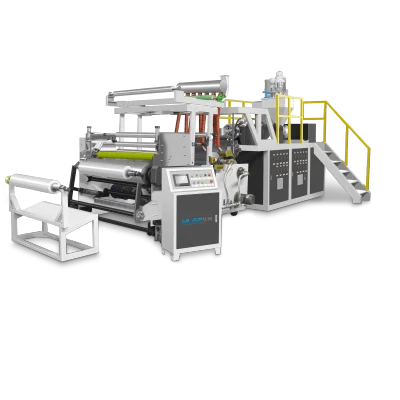
2-Layer Co-Extrusion Stretch Film Machine: Working Process & Operation
2026-08-31
Balancing material cost against structural strength has long been one of the hardest tradeoffs in stretch film production. Push for more puncture resistance and cost climbs with added gauge. Push for lower cost and the film risks failing exactly where a load needs it most. A 2-layer co-extrusion stretch film extrusion machine solves this bottleneck at the structural level, using an AB layer design that separates strength and cling into two purpose-built layers rather than asking a single material to do both jobs at once.
Why Single-Layer Stretch Film Keeps Running Into the Same Wall
A monolayer stretch film has no choice but to compromise. Puncture resistance and elastic cling pull in different directions chemically, and a single resin formulation can only be pushed so far toward one property before the other starts to suffer. Manufacturers trying to solve this the traditional way usually reach for the same lever: adding overall thickness. That approach does raise strength somewhat, but it also raises resin consumption and cost proportionally, without necessarily improving cling or sealing performance at all.
The limitations run deeper than material chemistry. Older single-layer lines typically lack the kind of precision co-extrusion system and real-time thickness feedback that keep output consistent from batch to batch. Without that feedback loop, gauge variation creeps in, and even a well-formulated resin ends up wrapped around a roll with weak spots that were never intended to be there. At higher line speeds
, inconsistent tension control compounds the problem further, leaving finished rolls with deformation or uneven winding that shows up the moment a customer starts using the stretch film.
Where the Gap Between Strength and Cling Actually Costs Money
These shortcomings are not abstract. They show up directly in specific segments where stretch film has to perform under real load conditions rather than ideal ones. Chemical drum and container pallet packaging is a clear example, since these loads are heavy, often have sharp edges or protruding fittings, and put enormous stress on the outer surface of the film during wrapping and transit. A monolayer film that compromises on puncture resistance to preserve cling is exactly the kind of product that tears against a drum rim or corner brace, and once the wrap fails at one point, the entire pallet loses its structural integrity.
Paper roll and textile roll packaging presents a different but equally demanding challenge. These loads are smooth-surfaced and typically large in diameter, which means the stretch film depends almost entirely on strong elastic recovery and sustained cling to hold tension over time rather than on surface friction. A single-layer stretch film that leans toward puncture resistance at the expense of cling struggles to maintain that grip, and rolls that seemed secure at the point of wrapping often arrive loose or visibly shifted after transport. In both cases, the underlying issue is the same: a single layer being asked to deliver two properties that genuinely need to be engineered separately.
Two Independent Extruders, Two Distinct Jobs
Our 2-layer co-extrusion stretch film extrusion machine is built around a straightforward principle: give each layer exactly one job, and engineer it to do that job as well as possible. Two independent extruders process distinct polymer formulations, drawing from LLDPE, LDPE, or metallocene resins depending on the performance target, and each layer is optimized for a specific function rather than a compromise between two.
The outer A layer is engineered specifically for puncture and tear resistance, giving the stretch film the structural backbone needed to stabilize heavy or irregularly shaped loads like chemical drums and palletized containers without failing at contact points. The inner B layer is optimized for high cling and elastic sealing, providing the sustained grip that smooth, large-diameter loads like paper and textile rolls depend on to stay tightly wound through handling and transport. These two molten layers converge through a precision multi-manifold T-die, which ensures a clean, stable interface between them and produces a genuinely unified stretch film structure rather than two layers loosely bonded together.

Precision Melt Control From Extrusion to Winding
Layer separation only delivers its full benefit when the rest of the process holds equally tight tolerances, which is why melt plastication and thermal management receive the same level of engineering attention as the layer structure itself. Advanced screw geometry keeps melt plastication stable and thermally consistent even at high output speeds, preventing the kind of localized inconsistency that would otherwise undermine the layer separation happening at the die.
A high-efficiency chill roll system delivers rapid, uniform quenching immediately after extrusion, which is essential for achieving the stretch film clarity and crystalline consistency that give the finished product both its visual quality and its mechanical predictability. Integrated gamma gauges and thickness feedback systems monitor the stretch film profile continuously, automatically adjusting the die in real time to keep thickness uniform not just across a single roll but from one production batch to the next, which is exactly the kind of consistency that chemical packaging and roll-goods customers depend on when they specify tight tolerances.
Keeping High-Speed Output Structurally Sound
None of these material and thermal advantages matter if the winding stage cannot keep pace, so the machine's automated winding system is engineered for the same level of stability. A dual-station turret winder enables non-stop roll changes without interrupting production, while precise tension control prevents the stretch film deformation that often shows up on less capable winding systems running at comparable speeds. The mechanical platform itself is built to maintain structural stability at high line speeds, so productivity gains do not come at the cost of roll quality.
The material efficiency gained from engineering each layer's properties independently compounds these benefits further. Because each layer is doing exactly the job it was designed for, overall resin consumption drops relative to a monolayer stretch film built to the same performance target, while the physical performance of the finished product actually improves rather than merely holding steady.
Built to Match Strength With Cling, Not Trade One for the Other
The core problem with monolayer stretch film was never really about material quality, it was about asking one layer to deliver two properties that work against each other by nature. A 2-layer co-extrusion stretch film extrusion machine resolves that conflict at the structural level, giving chemical drum packaging the puncture resistance it needs and giving paper and textile roll packaging the cling and elastic recovery theirs depends on, all from a single, unified film. For manufacturers looking to reduce resin cost without compromising on the performance customers actually notice in the field, engineering the layers separately rather than compromising within one is the difference that shows up in every pallet that arrives intact.