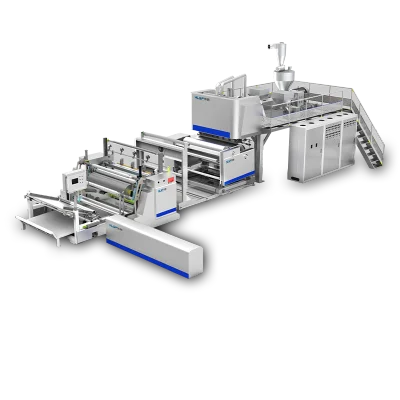
As palletized goods move through increasingly demanding manufacturing, warehousing, and logistics operations, stretch film packaging has become an important part of load stabilization. A well-wrapped pallet helps keep products together during handling, storage, and transportation, while consistent wrapping can also improve packaging efficiency and reduce unnecessary film consumption.
For companies still relying heavily on manual wrapping, differences in wrapping tension, film overlap, wrapping cycles, and operator technique can make it difficult to maintain consistent results. Repetitive manual wrapping can also require considerable operator time, particularly when pallet volumes increase.
This is where a stretch film making machine and automated wrapping equipment can provide a more controlled packaging process. However, not every company needs the same level of automation. Semi-automatic and full automatic stretch film machines are designed for different production environments, and understanding their differences is important when selecting the right solution.
Why the Right Level of Automation Matters
The main purpose of an automatic stretch film wrapping system is to make pallet wrapping more consistent while reducing the amount of manual work required. The machine controls key wrapping movements such as turntable rotation, film carriage movement, and film tension according to the selected program.
For a semi-automatic system, the operator generally remains involved in loading the pallet, starting the wrapping cycle, and handling the finished load. The machine performs the main wrapping operation, allowing the operator to avoid manually walking around the pallet with a film roll.
A full automatic system takes this process further by connecting the wrapping machine with conveyors or other material-handling equipment. Depending on the configuration, pallets can enter the wrapping area automatically, the machine can detect the load, complete the programmed wrapping cycle, cut the film, and transfer the wrapped pallet to the next stage.
The most suitable option depends on the company’s production volume, pallet flow, labor requirements, available installation space, and plans for future automation.
Semi-Automatic Stretch Film Machines
A semi-automatic stretch film machine is often a practical solution for companies that want to improve wrapping consistency without installing a complete automated packaging line.
In a typical application, a forklift or pallet truck places the load onto the turntable. The operator selects the appropriate wrapping program and starts the cycle. The machine then controls the rotation of the pallet and the vertical movement of the film carriage while maintaining the selected film tension.
After wrapping is completed, the operator normally handles the film tail and removes the pallet before preparing the next load. The exact operating procedure depends on the machine configuration and optional functions.
One of the main advantages of a semi-automatic system is flexibility. It can be installed as an independent packaging station without requiring a complete conveyor system. This makes it suitable for warehouses, manufacturing workshops, and distribution facilities where pallet volumes are moderate or product specifications change frequently.
A semi-automatic stretch film machine can also be a sensible step for companies moving from manual wrapping toward greater packaging automation. It reduces repetitive wrapping work while allowing operators to remain involved in pallet handling.
Full Automatic Stretch Film Machines
A full automatic stretch film machine is designed for applications where pallet wrapping forms part of a continuous production or logistics process.
Instead of relying on an operator to position every pallet and start each cycle manually, the wrapping machine can be integrated with a conveyor system. Sensors and programmed controls can be used to identify the pallet position and initiate the wrapping process according to the line configuration.
Depending on the selected equipment, automatic functions may include pallet detection, wrapping cycle control, film cutting, film tail handling, and automatic transfer to the next conveyor section.
This type of system is particularly suitable for manufacturing plants, distribution centers, and high-frequency warehouse operations where pallets are continuously moving through the packaging area. It can also be connected with upstream palletizing equipment and downstream conveying or storage systems.
The main value of full automation is not simply higher machine speed. It is the ability to create a more continuous and repeatable workflow with less manual intervention. This can be especially useful when packaging needs to follow a defined production rhythm.
Full Automatic vs. Semi-Automatic Stretch Film Machines
| Feature | Semi-Automatic Machine | Full Automatic Machine |
|---|---|---|
| Pallet loading | Usually operator-assisted | Can be connected to automatic conveyors |
| Wrapping cycle | Automatically controlled | Automatically controlled |
| Film tension | Set and controlled by the film carriage | Programmed and controlled automatically |
| Film cutting | Manual or optional automatic function | Automatic on suitable configurations |
| Pallet unloading | Usually operator-assisted | Can be connected to automatic conveying |
| Production environment | Independent packaging stations | Continuous production and logistics lines |
| Flexibility | High flexibility for different loads | Best for stable and repeatable pallet flow |
| Initial investment | Generally lower | Generally higher |
| System integration | Limited or optional | Designed for integration with other equipment |
Film Tension and Pre-Stretch Control
Automation level is only one part of wrapping performance. Film tension and pre-stretch control also have a direct influence on how effectively stretch film is applied to a pallet.
A modern stretch film making machine used in film production can manufacture film with controlled thickness and mechanical properties, while the downstream wrapping machine determines how that film is applied to the load. These two stages should therefore be considered separately.
During wrapping, excessive tension may place unnecessary pressure on lightweight cartons or deform products with weaker packaging structures. Insufficient tension, on the other hand, may result in a loose load that does not receive adequate stabilization.
Pre-stretch settings should be selected according to the film specification, load characteristics, and wrapping requirements. Higher pre-stretch is not automatically better for every application. The correct setting depends on the film's elongation and recovery characteristics as well as the weight, shape, and stability of the pallet.
Modern control systems allow operators to store and adjust wrapping parameters such as turntable speed, carriage speed, wrapping cycles, and film tension. This makes it easier to establish repeatable packaging conditions for different pallet types.

How to Choose the Right Stretch Film Machine
For companies handling a relatively small number of pallets or a wide variety of products, a semi-automatic machine can provide a practical balance between investment and automation. It is particularly useful when pallets are not continuously available and operators already perform forklift or material-handling tasks.
A full automatic system becomes more attractive when pallet flow is continuous and packaging needs to keep pace with an established production line. It is also suitable when the company wants to reduce manual intervention and connect pallet wrapping with conveyors, palletizers, or warehouse automation systems.
Before selecting equipment, manufacturers should consider several practical factors, including the number of pallets wrapped per day, pallet dimensions, maximum load weight, product stability, available installation space, film specifications, and existing material-handling equipment.
Future expansion should also be considered. A company that expects pallet volume to increase may benefit from selecting equipment that can later be integrated with additional conveying or automation functions.
A Suitable Stretch Film Machine for Your Packaging Needs
Choosing between a semi-automatic and full automatic stretch film machine should be based on actual production requirements rather than machine speed or purchase price alone. Factors such as pallet volume, load characteristics, film specifications, labor requirements, available installation space, and future automation plans all play an important role in determining the most suitable configuration.
Our stretch film machine solutions are available for different levels of packaging automation. Semi-automatic equipment is well suited to independent packaging stations, moderate pallet volumes, and applications where flexibility remains important. These systems provide adjustable film tension and controlled wrapping cycles while reducing the repetitive work associated with manual wrapping. For higher-throughput operations, our full automatic solutions can be integrated with conveying and material-handling systems to support a more continuous pallet wrapping process. Depending on the production layout, functions such as pallet detection, programmed wrapping cycles, automatic film cutting, and pallet transfer can be incorporated into the system.
The film carriage, tension control, turntable, lifting system, and control interface can be configured according to the customer's specific application instead of relying on a single standard setup. With the appropriate equipment configuration and properly adjusted wrapping parameters, manufacturers can establish a more consistent pallet packaging process while selecting an automation level that matches their current production needs and future development plans.