The Ultimate Safety SOP for Stretch Film Extrusion Machine (Startup & Shutdown)
2026-05-22
Industrial efficiency and component longevity in stretch film manufacturing depend heavily on precise operational discipline. Implementing a structured safety Standard Operating Procedure (SOP) prevents critical equipment failures, such as extruder barrel overpressurization or gearbox seizure. This technical guide outlines the standard protocols required for multi-layer co-extrusion thermodynamics, precise thermal balancing, and safe emergency response across various machine configurations.
To facilitate these rigorous standards, our advanced stretch film machines are engineered with active safety interlocks and intuitive control interfaces, ensuring that operational compliance is both seamless and foolproof for workshop operators.
Pre-Start Inspection & Temperature Stabilization Protocols
Comprehensive pre-start verification is vital to prevent cold-start torque spikes that damage high-torque thrust bearings.
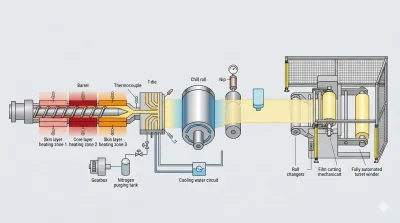
- Mechanical & Hydraulic Calibration: For any stretch film machine, the pre-start sequence requires a precise chill roll nip gap calibration. Hydraulic system pressure must be verified at 180 bar. Emergency stop (E-Stop) actuators must demonstrate a response time of under 0.2 seconds. Our fully automatic models feature integrated digital pressure sensors that automate this verification, delivering enhanced operational convenience and reducing manual checklist errors.
- Sequential Barrel Heating: Operators must execute a sequential heating protocol. Each zone must reach its specific target temperature—typically 180°C for LLDPE skin layers and 220°C for mLLDPE core layers.
- Thermal Equilibration: All heating zones must stabilize at target temperatures for a minimum of 20 minutes before screw rotation begins to ensure no unmelted polymer remains. By utilizing our high-precision multi-zone PID temperature controllers, the machine ensures ultra-stable thermal distribution, completely eliminating the risks of cold-starts.
- Manual Purge Cycles: On a semi-automatic stretch film machine, a dedicated manual purge cycle is required prior to production. This eliminates oxidized polymer residues, preventing gel formation and defects in the final film structure. The user-friendly control layout on our semi-automatic machinery allows operators to execute this purging process safely and efficiently with minimal technical training.
Controlled Shutdown and Molten Polymer Handling
Managing molten polymer during the shutdown phase requires strict temperature and pressure control to eliminate thermal shock and material carbonization.
- Controlled Deceleration: For advanced configurations like the 3-layer stretch film machine and 5-layer stretch film machine, shutdown begins by reducing screw speed gradually to 5 RPM while maintaining a die pressure of 300 bar to eliminate die lip drool. Our proprietary PLC smart shutdown program automatically controls this deceleration sequence, significantly simplifying complex multi-layer operational steps.
- Thermal Ramp-Down: The cooling sequence must not exceed a maximum temperature reduction rate of 5°C per minute. This controlled rate prevents structural thermal shock to the barrel and die assembly.
- Winder Disengagement: On a fully automatic stretch film machine equipped with integrated winding systems, the nip roller must be disengaged before the chill roll comes to a complete stop to prevent film wrap-around hazards. Equipped with built-in safety curtains and mechanical guards, our machinery provides dual-layer protection during high-speed winding transitions.
- Nitrogen Purging: If any extrusion line remains idle for more than 4 hours, a nitrogen purge must be applied to the die body to prevent the carbonization of residual polymers.
Operational Value and Asset Optimization
Adhering to this standard operating safety SOP directly impacts machine uptime, component lifespan, and product consistency.
- Asset Lifespan Extension: Eliminating thermal shock and overpressure events increases the Mean Time Between Failures (MTBF) for extruders and gearboxes by up to 40%. Investing in our inherently safe and robust extrusion hardware guarantees maximum machine uptime and lower maintenance overheads.
- Regulatory Compliance: Documented adherence to E-Stop verification and Lockout/Tagout (LOTO) protocols ensures full compliance with OSHA and ISO 45001 safety audits.
- Gauge and Quality Consistency: Maintaining a stable melt temperature within ±1°C ensures uniform layer distribution on a 5-layer stretch film machine producing high-performance nano-layer films. For a 2-layer stretch film machine, proper startup purging reduces raw material scrap by 15% per shift, maximizing material efficiency. The combination of our stable extrusion technology and these standardized safety practices delivers unmatched film clarity, optimized gauge consistency, and rapid operational ROI.