How to Add 5+ Years to the Lifespan of Your Stretch Film Extrusion Machine
2026-05-21
Maximizing the operational lifespan of a stretch film extrusion machine requires structured engineering protocols focused on minimizing mechanical fatigue, electrical stress, and thermal degradation. Whether configured as a high-speed fully automatic stretch film machine or a semi-automatic stretch film machine, optimizing the core extraction and drive systems dictates the machinery's total service life.
By eliminating high-maintenance components like traditional gearboxes and adopting advanced direct-drive engineering, long-term equipment stability can be achieved. Implementing the following four technical strategies ensures continuous performance and prevents premature component failure across single and multi-layer extrusion systems.
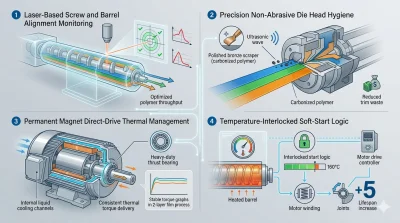
1. Laser-Based Screw and Barrel Alignment Monitoring
In multi-layer extrusion setups—particularly a 3-5-layer stretch film machine processing high-viscosity polymers—alignment friction inside the barrel can degrade throughput by up to 15% due to uneven wear patterns.
- The Technical Solution: Implementing laser-based wear measurements every 500 operating hours identifies radial deviation before it escalates into destructive galling.
- Application Benefit: This systematic monitoring is vital for stretch film machine where raw material feeding risks introducing microscopic particulates that accelerate barrel scoring.
2. Precision Non-Abrasive Die Head Hygiene
The die head assembly requires precise maintenance to prevent film gauge variations. Carbonized polymer buildup along the die lip edge is the primary catalyst for thickness inconsistency in a fully automatic stretch film machine.
- The Technical Solution: Utilizing non-abrasive bronze scrapers combined with low-torque ultrasonic cleaning tools removes polymer deposits without damaging the chrome-plated surface.
- Application Benefit: Maintaining a highly polished die lip surface stabilizes the layflat width and reduces edge trim waste by up to 8%, directly optimizing polymer yield.
3. Permanent Magnet Direct-Drive Thermal Management
Advanced extrusion systems utilize gearless direct-drive permanent magnet motors to eliminate mechanical transmission loss. Because there is no traditional gearbox, maintaining the motor's integrated cooling system and heavy-duty thrust bearings is paramount to extending drive train longevity under high continuous loads, such as in a 5-layer stretch film machine.
- The Technical Solution: Enforcing a strict schedule for liquid-cooling or forced-air fan maintenance prevents thermal demagnetization within the permanent magnet synchronous motor (PMSM).
- Application Benefit: Eliminating the mechanical friction of a gearbox inherently reduces native operating temperatures and prevents oil-leak risks. Continuous thermal monitoring safeguards the main thrust bearing, ensuring stable torque delivery for a 2-layer stretch film machine running continuous 24/7 cycles.
4. Temperature-Interlocked Soft-Start Logic
Cold-start mechanical shock damages high-torque drive systems even when a gearbox is absent. Attempting to initiate the main direct-drive motor when the barrel temperatures are below 160°C transmits extreme shear shock directly through the screw shank and thrust blocks due to un-melted resin resistance.
- The Technical Solution: Integrating an automated temperature interlock within the frequency inverter prevents motor ramp-up until the polymer melt viscosity inside the barrel reaches its precise target range.
- Application Benefit: This electronic control protocol safeguards the motor windings and mechanical joints, adding an estimated three to five years of operational service life to the main drive assembly.
Conclusion
Integrating these four technical pillars—structural wear monitoring, non-abrasive die hygiene, direct-drive thermal management, and automated cold-start logic—enables any stretch film extrusion machine to operate efficiently well beyond standard industrial depreciation curves.