How 2-Layer Bubble Film Extrusion Machine Achieve Perfect Lamination of Flat and Bubble Layers
2026-08-28
Getting the flat sealing layer to bond seamlessly with the bubble layer is one of the most persistent challenges in protective packaging production. It sounds like a small detail, but it determines whether a finished roll of bubble film holds air for months or starts leaking within weeks of leaving the factory. As a manufacturer of bubble film extrusion machine equipment, we have spent years refining exactly this part of the process, because it is where the real difference between an average bubble film and a genuinely durable one gets made.
The Hidden Cost of Adhesive-Bonded Bubble Film
Most conventional production lines still rely on adhesives or a secondary lamination step to join the flat film to the bubble layer. The two layers are formed separately, cooled, and then bonded afterward using glue or heat sealing. On paper this sounds straightforward, but in practice it creates a long list of downstream problems.
Adhesive bonds are inherently weaker than a true material fusion. Under the stress of folding, stacking, or repeated handling, the glued interface is often the first point of failure, and once it starts to separate the bubbles lose their cushioning pressure almost immediately. Because the bond sits at a distinct interface rather than within the material itself, even microscopic gaps in adhesive coverage can become channels for air leakage, which shortens the usable life of the film well before it ever gets used for its intended purpose.
There is also a cost and complexity penalty. Running adhesive application or a separate lamination pass means additional machinery, additional energy consumption, and additional labor, all of which add up across a production run. On top of that, adhesive layers turn what could be a single-material product into a mixed-material composite, which complicates recycling at a time when brand owners are under growing pressure to prove their packaging is genuinely circular. A film that cannot be cleanly reprocessed because of its adhesive layer is a film that is increasingly difficult to sell into markets with strict sustainability requirements.
Lamination Quality Shows Up Where It Matters Most
The quality of that bond is not just a manufacturing detail, it is something that shows up directly in how the film performs once it leaves the factory. In e-commerce fulfillment and logistics packaging, cartons pass through multiple sorting facilities, get stacked in transit, and are handled far more roughly than most shippers would like to admit. A bubble film with a weak adhesive bond is far more likely to develop delamination somewhere along that journey, and once it does, the cushioning effect drops sharply right when the product needs protection the most. That translates directly into higher damage rates and more customer claims for the businesses relying on that packaging.
The same issue shows up in a different way when bubble film is used to protect precision instruments, household appliances, and glass or ceramic goods. These items typically need long-term air retention rather than just a single trip's worth of protection, since products can sit in warehouses or retail packaging for extended periods before they are unpacked. Any weakness in the bond between the flat layer and the bubble layer becomes a slow leak that only becomes obvious once the product has already been damaged. For these applications, a genuinely fused structure is not a nice-to-have, it is the difference between a packaging solution that works and one that quietly fails.
Fusing Two Layers Into One During Extrusion
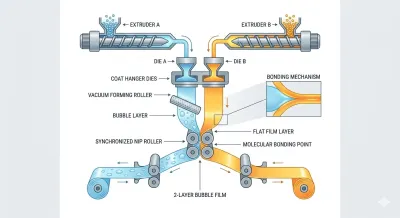
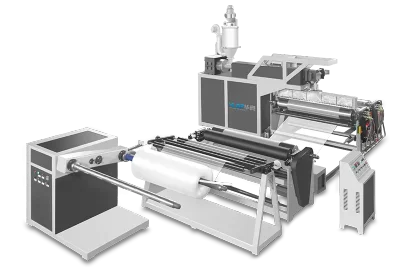
This is the exact problem our 2-layer bubble film extrusion machine is engineered to solve, by removing the need for adhesives altogether. Instead of forming the two layers separately, the machine extrudes both polymer melt streams at the same time. One stream is shaped into the bubble structure over a vacuum forming roller, while the second stream is simultaneously formed into the flat sealing layer.
The key step happens while both layers are still molten or semi-molten. At that point, a synchronized nip roller presses the two layers together, allowing them to fuse at a molecular level rather than simply stick together at a surface interface. Because the bond forms during the same continuous extrusion pass, there is no adhesive layer, no secondary process, and no seam where separation can start. What comes off the line is a single, homogeneous, airtight structure rather than two materials held together by glue.
This has a direct effect on recyclability as well. Since the finished film is a true monomaterial structure, it can be processed and recycled far more easily than an adhesive-laminated equivalent, which matters increasingly to brands trying to meet their own sustainability commitments without compromising on protective performance.
Stronger, Tighter, and More Consistent in Practice
The performance gains from this fusion process are not abstract, they show up directly in the applications where bubble film gets used every day. Because there is no adhesive interface to fail, the film retains its air cushioning for much longer, which is exactly what matters for the long-transit e-commerce shipments and long-storage precision goods described earlier. Puncture resistance also improves, since the fused structure behaves as a single material rather than two layers that can shear apart under stress, making the film better suited to protecting heavier or more awkwardly shaped items during transport.
Consistency is another benefit that matters more than it might first appear. Because the bonding happens automatically as part of the extrusion process rather than depending on even adhesive coverage, film quality stays uniform from the start of a production run to the end, which reduces the variability that often leads to customer complaints and rejected batches.
We offer this 2-layer bubble film extrusion machine in high-speed, medium-speed, and low-speed configurations, so the technology fits different production needs rather than forcing every customer into a one-size-fits-all setup. The high-speed configuration is built for manufacturers running high-volume orders, such as the large, standardized rolls consumed by e-commerce and logistics packaging operations, where maximizing output without sacrificing bond quality is the priority. The medium-speed configuration is aimed at producers who need a practical balance between throughput and flexibility, often serving customers with more varied order sizes and film specifications. The low-speed configuration gives operators finer control over the process, which makes it well suited to specialized applications like heavy-duty protective films or new product development, where precision matters more than raw output.
A Production Line Built Around Dependable Lamination
Perfect lamination is not just a manufacturing achievement, it is what allows bubble film to actually deliver on its job in the field, whether that means surviving a cross-country shipping route or protecting a fragile instrument sitting in storage for months. By building the bonding process directly into co-extrusion rather than treating it as an afterthought, our bubble film extrusion machine produces a film that is stronger, more airtight, and easier to recycle, without adding the cost and complexity that adhesives bring. For manufacturers who need protective packaging that holds up under real-world conditions, that is the kind of dependable performance worth building a production line around.