Five Key Mechanical Indicators When Purchasing 2-Layer Bubble Film Extrusion Machine
2026-09-01
Selecting the right 2-layer bubble film extrusion machine is a decision that shapes production quality, cost efficiency, and reliability for years, not just months. Yet many purchasing decisions still focus on a single headline number — usually output speed — while overlooking the mechanical fundamentals that actually determine whether that output speed translates into consistent, sellable film. Understanding what separates a well-engineered machine from an underspecified one starts with recognizing where conventional selection criteria fall short.
Key Factors to Consider When Selecting a Bubble Film Extrusion Machine
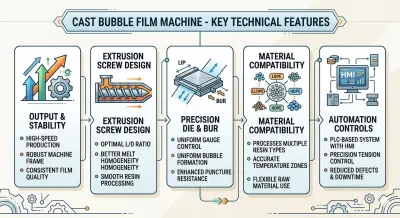
A common mistake in evaluating a bubble film extrusion machine is comparing rated output capacity without weighing it against structural stability. A machine that lists an impressive top speed but lacks the frame rigidity and thermal management to sustain that speed under continuous load often delivers a very different result on the production floor — overheating, vibration, and unstable bubble formation that quietly erode real-world throughput far below the number on the spec sheet.
Screw design is another area that gets oversimplified during selection. The length-to-diameter ratio, compression rate, and mixing element configuration all directly affect how thoroughly resin plasticizes before it reaches the die, yet these parameters are frequently treated as generic rather than matched to the specific resin blend a buyer intends to run. This becomes especially costly when processing recycled content or specialty resins, where uneven melt homogeneity shows up downstream as bubble instability, inconsistent gauge, and reduced optical clarity.
Die precision and blow-up ratio control receive even less scrutiny, despite governing two of the most fundamental film properties: bubble size and gauge consistency. A die machined to loose tolerances allows uneven polymer flow, which translates directly into gauge variation and inconsistent puncture resistance from one production run to the next. Without tight, repeatable control over blow-up ratio, film strength becomes difficult to guarantee across batches, which is a serious liability for any buyer trying to maintain a consistent product specification for customers.
Material compatibility is frequently assumed rather than verified. Many machines are nominally capable of processing LDPE, LLDPE, HDPE, and masterbatch blends, but in practice their screw geometry and barrel temperature zoning are optimized for only one or two of these materials. When raw material prices shift or a buyer needs to adjust formulation, a machine without genuine flexibility forces costly downtime or even mechanical modification rather than a simple parameter change.
Finally, automation is often treated as a convenience feature rather than a core reliability factor. Machines that rely heavily on manual temperature adjustment and tension control introduce operator-dependent variability into every roll produced, and that variability compounds when the line needs to integrate with downstream bag-making or slitting equipment. Without PLC and HMI-based control across precision temperature zones, consistency becomes difficult to sustain across shifts, let alone across the life of the machine.
Why These Indicators Matter Across Different Applications
These five mechanical fundamentals don't carry equal weight in every application, which is exactly why understanding them in context matters more than comparing spec sheets in isolation.
In electronics and precision instrument packaging, gauge consistency and cushioning uniformity are non-negotiable. A machine with imprecise die tolerances produces film with localized thin spots, and those thin spots become the exact locations where cushioning fails during transit — a risk no buyer serving this sector can absorb.
In pharmaceutical and personal care packaging, material flexibility is often the deciding factor, since these product lines frequently shift between LDPE and LLDPE formulations to balance clarity and strength for different product categories. A machine that requires extended changeover time or manual recalibration every time the resin blend changes struggles to keep pace with the smaller, more frequent production runs common in this sector.
In appliance and furniture packaging, output stability under sustained high-speed operation is what determines whether a line can actually support large-batch production schedules. A machine that loses bubble stability or thickness consistency as speed increases undermines the very throughput advantage it was purchased for, and the resulting variability in puncture resistance puts bulky, heavy products at greater risk of damage.

How Our 2-Layer Bubble Film Extrusion Machine Delivers on All Five Indicators
Our 2-layer bubble film extrusion machine is engineered so that output capacity and mechanical stability are designed together rather than treated as separate specifications. The frame, drive system, and thermal management are built to sustain rated speed under continuous, full-load operation, which is what allows appliance and furniture packaging customers to run large batches without the overheating or vibration issues that erode throughput on less rigorously engineered lines.
Screw design is matched to real production conditions rather than left generic. The length-to-diameter ratio, compression rate, and mixing element configuration are configured to deliver thorough, even plastication across a range of resin inputs, including recycled content and specialty blends. That consistency in melt homogeneity is what keeps bubble formation stable and gauge uniform, translating into film with the clarity and strength that customers expect regardless of the specific raw material mix being run that day.
Die precision and blow-up ratio control are held to tight, repeatable tolerances rather than loose approximations. Precision die machining ensures uniform polymer flow, which keeps gauge consistent and puncture resistance reliable from the first roll of a run to the last. For electronics and precision instrument packaging, that consistency is what prevents the localized thin spots that compromise cushioning exactly where products need protection most.
Material compatibility is built into both the screw geometry and the barrel's zoned temperature control, allowing the machine to process LDPE, LLDPE, HDPE, and masterbatch formulations without mechanical modification. For pharmaceutical and personal care packaging customers who need to move between formulations to match different product requirements, this flexibility means adapting to a new resin blend is a parameter adjustment, not a maintenance event — and it gives buyers real latitude to respond to raw material price shifts without disrupting production schedules.
Automation is integrated through PLC and HMI-based control spanning precision temperature zones and tension management, reducing dependence on manual adjustment and the variability that comes with it. This level of control also allows the machine to integrate smoothly with downstream bag-making and slitting equipment, which matters most in high-volume operations where every additional touchpoint is an opportunity for inconsistency or downtime to creep in.
Taken together, these five indicators — output stability, screw design, die precision, material compatibility, and automation — are not independent checkboxes but a connected system, and that is exactly how our 2-layer bubble film extrusion machine is engineered. For buyers evaluating equipment for electronics, pharmaceutical, appliance, or any other demanding packaging application, the real measure of a machine isn't its rated top speed in isolation, but whether all five of these fundamentals hold together under real production conditions, run after run.