Troubleshooting 5 Common Issues in a Stretch Film Extrusion Machine
2026-08-17
In the highly competitive packaging industry, production stability has become one of the most important factors affecting manufacturing profitability. For stretch film producers, achieving high output is not only about increasing machine speed but also about maintaining consistent film quality, reducing material waste, and improving overall production efficiency. A stable production process directly influences operating costs, customer satisfaction, and long-term market competitiveness.
However, many manufacturers still face technical bottlenecks caused by outdated equipment, unstable processing conditions, and limited automation. Problems such as uneven film thickness, frequent film breakage, poor layer bonding, surface defects, and long downtime can reduce production efficiency and increase unnecessary costs. With the development of modern extrusion technology, advanced stretch film extrusion machine solutions are helping manufacturers overcome these challenges through precise control systems, multi-layer co-extrusion technology, and intelligent automation.
The Essential Role of Stretch Film in Modern Logistics and Packaging
Stretch film has become an essential packaging material in global logistics, warehousing, manufacturing, and transportation industries. High-quality stretch film provides excellent load stability, protecting goods from dust, moisture, contamination, and shifting during storage and long-distance transportation. Whether used for pallet wrapping, industrial packaging, agricultural applications, or export logistics, reliable stretch film performance directly affects the safety of packaged products.
At the same time, the demand for thinner yet stronger packaging materials continues to grow. High-performance stretch film with excellent tensile strength, puncture resistance, and elongation capability allows end users to reduce film consumption while maintaining reliable protection. This creates significant cost advantages by lowering raw material usage and improving packaging efficiency.
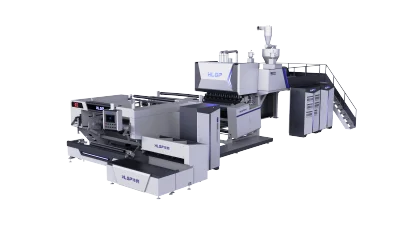
To meet these market requirements, manufacturers need production equipment capable of producing stable and high-performance films. A modern stretch film extrusion machine is designed not only for continuous production but also for precise control of film thickness, layer structure, mechanical properties, and energy efficiency.
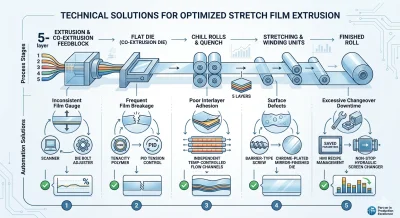
Uneven Film Thickness: A Major Challenge in Stretch Film Production
Film thickness variation is one of the most common problems affecting stretch film quality. Traditional extrusion systems may experience unstable melt pressure, inconsistent material flow, or inaccurate manual adjustment of the die lip. These problems can result in uneven thickness distribution, weak areas in the film, and excessive material consumption.
For manufacturers producing large volumes of stretch film, even small thickness deviations can create significant economic losses over time. Areas that are too thin may reduce packaging strength, while areas that are too thick increase raw material costs without improving performance.
Modern stretch film extrusion machine technology addresses this issue through automatic thickness control systems. Advanced production lines can integrate online thickness measurement sensors with automatic gauge control (AGC) systems to monitor film thickness in real time. The system analyzes thickness data continuously and automatically adjusts processing parameters to maintain stable output. With optimized die design, precise melt distribution, and closed-loop control, high-end extrusion lines can achieve thickness accuracy within approximately ±1.5%, depending on material conditions and machine configuration.
Frequent Film Breakage During High-Speed Production
Film breakage can significantly reduce production efficiency and increase downtime. Traditional single-layer or basic two-layer extrusion systems may have limitations when producing thinner films at higher speeds. Excessive thermal degradation, unstable cooling conditions, and improper winding tension can create internal stress that leads to tearing during stretching or packaging operations.
Another important factor is material structure. Modern stretch films often require a combination of strength, elasticity, and puncture resistance, which can be difficult to achieve with a simple single-material structure.
Multi-layer co-extrusion technology provides an effective solution. A three-layer or five-layer stretch film extrusion machine can combine different polymer materials within separate layers to optimize overall film performance. For example, the outer layers can provide excellent surface characteristics and puncture protection, while the core layer can improve toughness and stretching capability.
In addition, advanced winding systems with precise tension control help maintain stable film handling during high-speed operation. PID-based tension regulation allows the machine to automatically adjust winding conditions according to production speed, reducing the risk of film damage and improving finished roll quality.
Poor Layer Adhesion and Film Delamination Problems
For multi-layer stretch film production, layer bonding performance is a critical factor affecting product reliability. Delamination usually occurs when different polymer layers fail to achieve sufficient molecular bonding during the extrusion process.
Traditional equipment may suffer from uneven melt distribution, unstable temperature control between layers, or poor flow channel design. These problems can create weak interfaces where layers separate during stretching, transportation, or application.
Advanced co-extrusion systems solve this challenge through optimized multi-manifold die structures and independent temperature control technology. A five-layer stretch film extrusion machine allows manufacturers to precisely manage each layer’s material flow and processing conditions. Stable melt temperature and uniform distribution improve molecular interaction between layers, enhancing peel strength and overall film durability.
This technology enables producers to develop customized stretch films for different applications, including heavy-duty industrial packaging, export pallets, food packaging, and high-performance logistics solutions.
Surface Defects: Crystals, Bubbles, and Melt Fracture Issues
Surface quality is another important factor influencing the appearance and performance of stretch film. Common defects include fish eyes, crystal points, air bubbles, and shark skin patterns. These issues are usually related to poor melt homogenization, excessive shear stress, contamination, or unstable extrusion conditions.
Older extrusion equipment may have limitations in screw design and melt processing capability. Excessive shear heat can damage polymer properties, while dead zones inside the barrel or die may cause material degradation and surface imperfections.
Modern stretch film extrusion machine designs focus on improving melt quality through advanced screw structures, optimized barrel designs, and precision-engineered T-dies. Barrier-type screws can provide better plasticization and mixing performance, ensuring more uniform melt flow before entering the die.
High-quality mirror-finished dies with optimized flow channels reduce material retention areas and improve film surface consistency. Combined with accurate temperature control systems, these improvements help manufacturers produce clearer, smoother, and more reliable stretch film products.
Excessive Downtime During Product Changeovers
Production downtime is a major factor affecting equipment efficiency and overall operating costs. Many traditional extrusion lines require significant manual adjustment when changing film specifications, materials, or thickness settings. Operators often need to rely on experience to adjust temperatures, speeds, and tension parameters, which increases setup time and creates quality fluctuations.
Modern intelligent extrusion systems improve this process through automation and digital management. Advanced HMI control systems allow operators to store and recall production recipes for different film products, reducing adjustment time and improving repeatability.
In addition, automatic hydraulic screen changers help maintain continuous production by reducing the need for frequent manual filter replacement. These technologies can significantly shorten downtime during production changes and improve overall equipment effectiveness (OEE).
Building More Efficient Stretch Film Production with Advanced Extrusion Technology
At the forefront of efficient stretch film production, our stretch film extrusion machine solutions are designed to help manufacturers achieve stable output, lower energy consumption, and consistent film quality. By integrating advanced extrusion technology, precise temperature control, automatic thickness adjustment, intelligent HMI systems, and optimized winding units, our machines provide reliable performance for different production requirements, from standard packaging films to high-performance multi-layer stretch films.
With professional engineering support and customized configurations, we help customers improve production efficiency, reduce material waste, and enhance market competitiveness. Investing in our stretch film extrusion machine means choosing a long-term production partner dedicated to delivering durable equipment, practical solutions, and sustainable value for the global packaging industry.