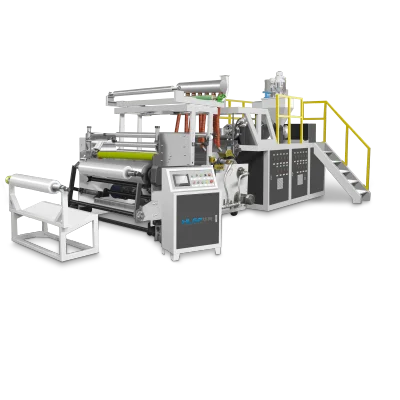
Key Differences Between 2-Layer and 7-Layer Stretch Film Machines
2026-08-13
The demand for high-quality stretch film continues to increase as logistics, warehousing, export transportation, and industrial packaging become more complex. Modern packaging manufacturers are not only looking for films that can wrap products but also require stable stretching performance, reliable load holding force, consistent thickness, and efficient material utilization. These requirements have encouraged the development of different stretch film production technologies, including 2-layer and 7-layer co-extrusion systems.
A stretch film extrusion machine directly determines the structure, performance, and production efficiency of the final film. While a 2-layer stretch film machine focuses on producing stable and economical stretch film with a simpler configuration, a 7-layer stretch film machine provides greater flexibility through advanced multi-layer co-extrusion technology. The main difference between these two systems is not only the number of film layers, but also the extrusion configuration, material distribution capability, and application range.
The Role of Stretch Film Extrusion Machine in Modern Film Production
Stretch film is widely used for pallet wrapping, warehouse storage, transportation protection, and industrial packaging. The primary function of stretch film is to secure products during handling and transportation by creating stable wrapping force around the load. A high-quality film should provide balanced stretching ability, adhesion performance, and mechanical strength while maintaining efficient material consumption.
The production process of a stretch film extrusion machine has a direct influence on these characteristics. Factors such as extrusion stability, layer distribution, temperature control, and thickness accuracy all affect the final film quality. For manufacturers, choosing the correct machine structure is essential because different film applications require different levels of performance optimization.
A simple two-layer structure may already meet the requirements of standard packaging markets, while complex industrial applications may require a multi-layer structure that allows different materials to perform different functions within the same film.
2-Layer Stretch Film Machine: Efficient Equipment for Standard Packaging Applications
A 2-layer stretch film machine is designed for manufacturers who mainly produce standard stretch film products. This type of equipment uses one extrusion system combined with a two-layer co-extrusion cast film die. The single extruder processes the polymer material, and the die structure forms the two-layer film through controlled material distribution.
Because of its relatively simple extrusion configuration, the 2-layer stretch film extrusion machine has advantages in operation stability, equipment management, and maintenance efficiency. With fewer process units compared with multi-layer systems, operators can adjust production parameters more easily, making it suitable for companies that focus on stable output and conventional stretch film production.
Although the structure contains only two layers, the film can still achieve essential packaging functions through reasonable material selection and process control. The two layers can be designed with different roles, such as improving surface adhesion, supporting stretching performance, and maintaining film flexibility. This makes the 2-layer structure suitable for applications where basic wrapping performance and production economy are the main considerations.
In practical applications, 2-layer stretch film machines are commonly used for producing films applied in warehouse packaging, pallet wrapping, e-commerce logistics, and general industrial transportation. For customers entering the stretch film market or targeting standard packaging requirements, this machine configuration provides an effective balance between investment cost, production efficiency, and product performance
7-Layer Stretch Film Machine: Advanced Multi-Layer Solution for High-Performance Films
A 7-layer stretch film machine represents a more advanced approach to stretch film production by using multi-layer co-extrusion technology. Unlike a 2-layer system, a 7-layer machine is equipped with five independent extrusion systems and a seven-layer co-extrusion cast film die. Each extrusion system can process different polymer materials, allowing manufacturers to precisely control the composition and function of each layer.
The main advantage of this structure is the increased flexibility in material distribution. Instead of relying on a simple two-layer combination, the seven-layer structure allows different layers to perform specific functions. Surface layers can be optimized for adhesion and film appearance, intermediate layers can improve toughness and strength, while core layers can focus on elasticity and overall film performance.
This multi-layer design provides more possibilities for producing high-performance stretch film. By adjusting layer ratios and selecting suitable materials, manufacturers can improve important properties such as tensile strength, puncture resistance, and load retention. These advantages are particularly valuable for applications involving heavy pallets, long-distance transportation, irregular-shaped products, and demanding industrial packaging conditions.
Another important feature of a 7-layer stretch film extrusion machine is its ability to optimize material usage. Different layers can use different grades of polyethylene materials according to their functions, allowing manufacturers to place higher-performance materials only where they are needed. This approach helps achieve a balance between film performance and production cost while providing more options for customized film development.
However, the advanced structure of a 7-layer system also requires more precise production control. Multiple extrusion units, temperature zones, melt flow management, and layer thickness control need to work together to maintain stable film quality. Therefore, 7-layer machines are generally selected by manufacturers who require higher film performance, greater product customization, or access to premium packaging markets.
| Comparison | 2-Layer Stretch Film Machine | 7-Layer Stretch Film Machine |
|---|---|---|
| Extrusion System | 1 extrusion system | 5 independent extrusion systems |
| Film Structure | Two-layer co-extrusion | Seven-layer co-extrusion |
| Material Control | Basic material distribution | Flexible multi-layer material combination |
| Film Performance | Suitable for standard stretch film production | Suitable for high-performance stretch film production |
| Production Complexity | Simpler operation and maintenance | Requires more precise process control |
| Main Advantages | Stable production and cost-effective operation | Better film customization and performance optimization |
| Typical Applications | General logistics, warehouse packaging, pallet wrapping | Industrial packaging, export transportation, demanding applications |
2-Layer and 7-Layer Stretch Film Machine: Key Technical Differences
The fundamental difference between a 2-layer and 7-layer stretch film machine lies in their extrusion structure and material control capability. A 2-layer machine uses one extrusion system to produce a basic two-layer film structure, which is suitable for standard stretch film applications. A 7-layer machine uses five independent extrusion systems to create a more complex seven-layer structure, providing greater flexibility for material combination and performance optimization.
From a production perspective, the 2-layer system offers simpler operation and lower equipment complexity, while the 7-layer system provides more advanced control over film properties. Neither configuration is suitable for every application; the right choice depends on the required film performance, market positioning, and production objectives.
Manufacturers producing conventional stretch film for general logistics applications may benefit from the efficiency and practicality of a 2-layer stretch film machine. Companies targeting high-performance films for industrial packaging, export transportation, or specialized applications may find the additional layer control of a 7-layer stretch film machine more suitable.
Choosing the Right Stretch Film Extrusion Machine for Your Production Needs
Selecting between a 2-layer and 7-layer stretch film extrusion machine requires consideration of several factors, including product requirements, customer expectations, production scale, and future market development. A machine with more layers does not automatically mean it is the best choice for every manufacturer. The ideal solution should match the intended film application and business strategy.
For standard stretch film production, a 2-layer machine provides reliable performance with a simpler production process. For manufacturers who need greater flexibility in film structure and want to develop higher-value products, a 7-layer machine offers more opportunities through advanced co-extrusion technology.
Advanced Stretch Film Extrusion Machine Solutions for Reliable Film Production
With the continuous development of global packaging industries, manufacturers need equipment that can provide stable production, consistent film quality, and flexible application options. We provide professional stretch film extrusion machine solutions designed for different production requirements, including efficient 2-layer systems and advanced 7-layer co-extrusion systems.
Our machines are developed with stable extrusion technology, precise process control, and reliable mechanical structures to help customers produce high-quality stretch film products for various markets. Whether the requirement is standard pallet wrapping film or high-performance industrial packaging film, our equipment can be configured according to production goals, material selection, and application needs.
By combining practical engineering experience with continuous equipment improvement, we help global customers achieve efficient, stable, and competitive stretch film production.