How Stretch Film Extrusion Machine Achieve Low-Noise Operation
2026-05-11
In high-speed production environments, the acoustic output of stretch film extrusion machinery often exceeds 85 dB. Excessive noise is more than a workplace hazard; it is a symptom of mechanical inefficiency, vibration, and energy loss.
Modern stretch film machines—ranging from 2-layer and 3-layer to advanced 5-layer configurations—utilize precision engineering to suppress noise at the source. Below are the core technologies that enable high-output extrusion with noise levels maintained below 78 dB.
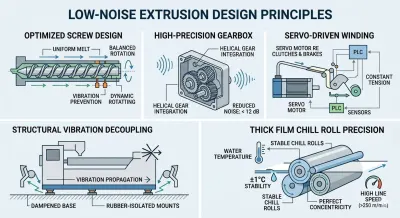
1. Optimized Balanced Screw Design
The extrusion process begins with the screw and barrel. Conventional systems often suffer from harmonic resonance due to unbalanced rotational dynamics.
- Precision Helix Geometry: Digitally optimized screw profiles ensure uniform melt pressure.
- Dynamic Balancing: By eliminating minor imbalances in the screw shaft, the machine prevents the propagation of vibration-induced sound waves, even at high RPMs.
2. High-Precision Gearbox Transmission
The gearbox is a primary source of mechanical "whine." Modern stretch film extrusion lines replace crude spur gears with advanced transmission systems.
- Helical Gear Integration: Case-hardened, ground helical gears provide smoother tooth meshing.
- Noise Reduction: This transition reduces meshing noise by up to 12 dB compared to standard gear drives, delivering consistent torque without mechanical chatter.
3. Servo-Driven Winding Systems
The winding section is the most acoustically sensitive zone of the machine. Whether in a full-automatic stretch film winding machine or a semi-automatic unit, the shift to servo technology is critical.
- Mechanical Simplification: Servos replace traditional pneumatic clutches and brakes, which are prone to friction noise.
- Real-Time PLC Control: Servos maintain constant tension through millisecond-level feedback loops, preventing the "banging" or vibration caused by sudden acceleration or deceleration.
4. Structural Vibration Decoupling
Noise often travels through the machine frame and into the factory floor. Low-noise stretch film machines employ structural dampening to break this path.
- Dampened Machine Bases: Reinforced frames absorb kinetic energy.
- Rubber-Isolated Mounting: Decoupling the extrusion unit from the floor prevents structure-borne noise propagation throughout the facility.
5. Thermal Stability and Chill Roll Precision
Mechanical fluctuations during high-speed cooling can generate rhythmic noise.
- Stable Chill Rolls: Precision-engineered cooling rollers maintain perfect concentricity, reducing "thumping" at high line speeds (exceeding 250 m/min).
- Temperature Accuracy: Maintaining a tolerance within ±1°C ensures consistent polymer viscosity, which stabilizes the motor load and reduces acoustic fluctuations.
Conclusion: Engineering for Efficiency
Achieving low-noise operation in stretch film extrusion is an indicator of superior mechanical build quality. By integrating balanced screw extrusion, helical gear transmissions, and servo-driven winding, these systems meet strict ISO and health-and-safety standards while ensuring a more stable, high-yield production environment.