Guide to Consistent Production of 0.01mm Ultra-Thin Stretch Film
2026-09-07
Producing stretch film at 0.01mm forces a level of precision that most extrusion lines were never designed to hold. At that gauge, film thickness, tensile strength, and puncture resistance all have to be controlled at a microscopic scale simultaneously, and there's almost no margin for drift. A deviation of just one micron is enough to trigger web breaks, inconsistent cling, and scrap rates that make the whole point of running ultra-thin film — saving material — disappear into wasted output instead.
Why Standard Extrusion Lines Struggle at This Gauge
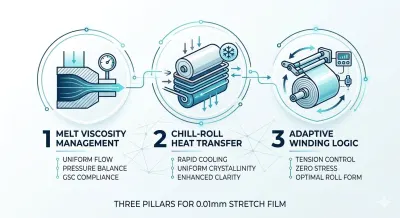
The core problem is that gauge uniformity gets exponentially harder to hold as film thickness drops, and most conventional stretch film extrusion machine setups simply weren't engineered with that scale in mind. Achieving consistent quality at 0.01mm requires advanced co-extrusion technology, precise melt viscosity control, and automated winding logic working together — a standard line missing any one of those three tends to show it immediately in the finished roll. Without tight control over melt viscosity, polymer flow becomes uneven across the die width before the film has even reached the chill roll. Without rapid, uniform heat transfer at the chill roll, film crystallinity and clarity come out inconsistent from one section of a roll to the next. And without adaptive winding logic, internal stress builds up in the finished roll and shows up later as deformation during storage — a defect that doesn't even reveal itself until the film has already shipped.
0.01mm Stretch Film Production: Why Thickness Control Matters
The appeal of 0.01mm film is straightforward: less material per roll means lower cost per wrap, which matters most in operations running high volumes on tight margins. But that appeal only holds if the film performs consistently, and that's exactly where standard equipment runs into trouble.
Fresh produce pallet packaging is extremely cost-sensitive by nature, and ultra-thin film offers a real reduction in per-roll material cost in this application. The problem is that uneven gauge on a standard line drives up film breaks during high-speed wrapping, and every break means manual rewrapping — which quietly erases the labor savings that ultra-thin film was supposed to deliver in the first place.
Packaging materials wholesalers palletizing corrugated boxes and other bulk supplies ship at high frequency and watch shipping weight closely. When a standard extrusion line can't hold 0.01mm consistently, the practical fallback is running a thicker film instead, which adds weight and cost across every outbound shipment rather than solving the underlying problem.
Household and plastic goods distributors moving high volumes of mixed SKUs face frequent changeovers between product runs. On standard equipment, ultra-thin film production tends to be unstable across these changeovers, so roll quality varies noticeably from one batch to the next — which is a hard problem for a distributor trying to maintain a consistent pallet-wrapping standard across a constantly shifting product mix.
Matching Machine Configuration to Ultra-Thin Gauge Requirements
Consistent 0.01mm production depends on matching the right co-extrusion configuration to the application, since gauge control, structural stability, and cost efficiency don't scale the same way across every layer count.
Our 5-layer stretch film machine delivers the highest level of thickness control in the lineup. Dedicated skin layers work alongside a symmetrical core structure, and this co-extrusion platform allows precise manipulation of melt viscosity across each individual layer rather than treating the film as a single uniform mass. High draw-down production, combined with premium LLDPE resins, keeps polymer flow uniform all the way from the die exit to the chill roll, and rigorous temperature management holds deviations under ±1°C across the adapter and die zones — tight enough to prevent gauge banding and preserve consistent film orientation. That level of thickness control is exactly what addresses the fresh produce packaging problem described above: fewer breaks during wrapping means the material savings from going ultra-thin actually reach the bottom line instead of being absorbed by rework.
The 3-layer stretch film machine takes a different approach, built around a symmetrical A/B/A structure with a high-stiffness core layer that optimizes process control and film performance together. The engineered structure prevents interlayer slip, so ultra-thin web passes through the nip rollers without wrinkling even at reduced gauge. Dual-pressure sensors provide balanced automated winding tension that prevents telescoping and air entrapment during high-speed winding, and the system consistently produces stable rolls weighing up to 300kg with precise alignment from the core to the outer layer. That structural stability and large-roll capability are well suited to packaging materials wholesalers running high-frequency, high-volume pallet operations, where a roll that holds its shape and alignment under sustained high-speed use matters as much as the gauge itself.
For applications where a lower-gauge entry point makes more sense, the 2-layer stretch film machine provides a stable, cost-efficient solution for essential thin-film production. Modern 2-layer lines incorporate mechanical upgrades specifically to handle low gauges without film deformation, including closed-loop tension control that uses servo-driven systems to automatically adjust winding tension based on real-time thickness feedback. Optimized heat transfer through high-efficiency chill rolls ensures rapid cooling and exceptional roll formation, and a zero neck-down design lets the machine reliably deliver 0.01mm film while maintaining a consistent 14-16 gram pre-stretch capability. This configuration gives household and plastic goods distributors a dependable, lower-complexity way to produce ultra-thin film consistently across the frequent changeovers their mixed-SKU operations require.
The Technical Pillars Behind Stable 0.01mm Output
Across all three configurations, stable ultra-thin production comes down to the same three interconnected factors working in coordination. Melt viscosity management controls polymer flow uniformity through every die channel, which is the foundation everything else depends on. Chill-roll heat transfer ensures rapid, uniform cooling that locks in film crystallinity and clarity before any inconsistency can set in. Adaptive winding logic eliminates internal stress and prevents roll deformation during storage, so the film that leaves the plant in spec stays in spec by the time it reaches the customer.
Precision Engineered for the Gauges That Matter Most
Producing 0.01mm stretch film reliably isn't a matter of running a standard line slower or tuning it more carefully — it requires equipment built from the ground up for microscopic gauge control. Whether the priority is the maximum thickness precision of a 5-layer platform, the structural stability and large-roll output of a 3-layer system, or the cost-efficient entry point of a 2-layer line, each of our stretch film extrusion machine configurations is engineered to hold the tolerances that ultra-thin production demands. If your current line is losing the material savings of thin-gauge film to breaks, rework, or inconsistent rolls, it's worth talking to us about which configuration is built to solve that at the source.