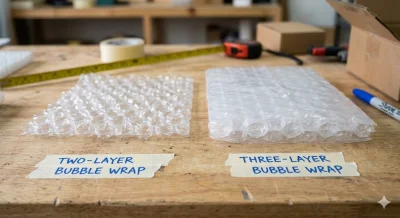
Choosing between 2-layer and 3-layer bubble film depends on how the packaging will be used, handled, and transported. Both structures use polyethylene film and trapped air to provide cushioning, but their layer arrangements create different surface characteristics and levels of structural reinforcement. For general shipping, storage, and product protection, 2-layer bubble film can provide an economical cushioning option. When packaging requires smooth surfaces on both sides or additional protection around the bubble layer, 3-layer construction offers a different balance of durability, handling, and processing characteristics.
Common Missteps in Bubble Film Selection
Bubble film is sometimes selected mainly according to purchase price or nominal film thickness, while the actual packaging conditions receive less attention. This can create problems when the material is exposed to sharp edges, repeated handling, compression, or long-distance transportation.
A 2-layer structure has one exposed bubble surface, so direct contact with rough or angular products can place greater stress on the bubble layer. If the film is too thin for the application, individual bubbles may be damaged during wrapping or handling. Long-term compression can also reduce cushioning performance as bubbles deform under load. These risks do not mean that 2-layer film is unsuitable for demanding packaging, but they show why film structure, thickness, bubble size, resin formulation, and packaging conditions need to be considered together.
For manufacturers, the more useful question is therefore not simply which structure costs less, but whether the selected construction provides the surface protection, handling characteristics, and cushioning performance required by the finished package.
Bubble Film's Role in Protective Packaging
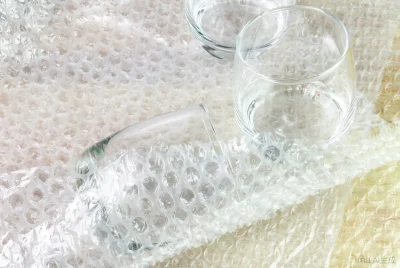
Bubble film is widely used because its air-filled structure provides cushioning without adding the weight of a solid protective material. It can be used for wrapping consumer goods, electronics, glass products, ceramics, furniture components, industrial parts, and other items that require separation from impact and surface abrasion during handling and transportation.
The required level of protection varies considerably between applications. Lightweight products with relatively smooth surfaces may not require the additional flat layer used in 3-layer construction. Products with irregular edges or packaging processes that require smooth contact surfaces can create different requirements.
This is where the distinction between 2-layer and 3-layer bubble film becomes important. The difference is not simply the number of layers. It changes how the bubble layer is positioned within the finished film and therefore affects how the material interacts with the packaged product and the surrounding packaging system.
Structural Design Separates the Two Formats
The basic construction of 2-layer bubble film consists of a flat polyethylene layer bonded to a molded bubble layer. One side therefore has a relatively smooth surface, while the opposite side exposes the bubble pattern. This structure uses less material than a comparable 3-layer construction and can be suitable for general-purpose cushioning, surface protection, void filling, and wrapping applications where a single smooth surface is sufficient.
3-layer bubble film uses a flat-bubble-flat structure. The molded bubble layer is enclosed between two flat polyethylene layers, creating smooth surfaces on both sides. The additional outer layer separates the bubbles from direct contact with the packaged product and the external environment.
This construction can be useful when the film needs greater surface protection around the bubble layer or when both sides of the material will come into contact with products, packaging equipment, or other materials. However, the actual strength and durability of either structure also depend on film thickness, bubble diameter, polyethylene grade, sealing quality, and production consistency.
Air Retention and Load Stability
The enclosed bubble structure of 3-layer film provides an additional polyethylene layer over the molded bubbles. This can help protect the bubble layer from direct abrasion and mechanical contact during wrapping, transportation, and handling. For applications involving repeated handling or products with irregular surfaces, this additional layer can provide a useful structural advantage.
Load behavior also depends on more than layer count. Bubble diameter, film thickness, material formulation, and the distribution of the applied load all influence how individual air cells respond to compression. A 3-layer structure provides a more enclosed bubble construction, but it should not automatically be assumed to withstand every type of load better than a 2-layer film with different specifications.
For long-distance transportation, manufacturers should therefore evaluate the complete film specification rather than using layer count alone as a measure of cushioning performance. In particular, packaging tests under realistic compression, impact, and handling conditions can provide a more reliable basis for selecting the appropriate structure.
Surface Performance and Processing Characteristics
One of the clearest structural differences is the surface configuration. Because 3-layer bubble film has a flat polyethylene layer on both sides, both surfaces are relatively smooth. This can make the material easier to position between products, packaging components, or other protective materials where direct contact with exposed bubbles would be undesirable.
2-layer film has one smooth side and one bubble-textured side. The exposed bubble surface can provide useful cushioning and separation, but it creates a different contact condition during wrapping and handling.
The smooth surfaces of 3-layer film can also provide a more suitable substrate for certain downstream processes, depending on the film formulation and surface treatment. Printing, lamination, coating, and composite construction can be incorporated when the finished material is designed for these processes. For example, a 3-layer bubble structure can be laminated with kraft paper or a reflective foil layer when the application requires additional surface protection, appearance, or reflective properties. These capabilities depend on the specific film design and converting process rather than on the three-layer structure alone.
Matching Machine Capability to Structural Demand
Producing consistent bubble film requires extrusion equipment that matches the required layer structure, film width, thickness, bubble size, and output level. A 2-layer bubble film extrusion machine generally uses a simpler extrusion configuration because the film consists of a flat layer and a bubble layer. The production line must still maintain stable melt temperature, extrusion output, bubble formation, cooling, and film winding to achieve consistent results.
A 3-layer bubble film extrusion machine adds another flat film layer to the structure. The extrusion system therefore needs to coordinate the additional material stream with the bubble-forming process and maintain stable bonding between the layers. Die design, temperature control, extrusion output, cooling conditions, and layer distribution all influence the consistency of the finished film.
The choice between the two machine configurations should therefore follow the required film structure rather than being based on layer count alone. A 2-layer line can be appropriate when the target product is general-purpose bubble film and production cost is a major consideration. A 3-layer line becomes more relevant when the product specification calls for a flat outer layer on both sides, additional protection around the bubbles, or compatibility with specific downstream converting processes.
For manufacturers evaluating a new bubble film extrusion machine, the practical comparison should include layer configuration, film thickness range, bubble dimensions, extrusion capacity, resin compatibility, cooling system, winding method, and the intended end-use specification. Matching these machine parameters with the finished film requirement provides a more reliable basis for equipment selection than treating 2-layer or 3-layer construction as a simple measure of overall film quality.