The Principle of Multi-Zone Heating in Bubble Film Extrusion Machine
2026-08-24
Film quality in bubble film extrusion comes down to a single underlying factor more often than manufacturers expect: how precisely temperature is controlled from the moment resin enters the extruder to the moment it leaves the die. When that control is imprecise, the effects rarely show up as one obvious defect. Instead they surface as a pattern of small inconsistencies that are frustrating to diagnose and expensive to keep correcting.
The Limits of Single-Zone Heating
Many extrusion setups still rely on a single heating zone to manage the entire barrel, treating the whole length of the extruder as though the resin behaves the same way from start to finish. In reality, polymer flow behavior changes dramatically as material moves from solid pellets to a fully melted stream, and different polymer grades bring their own thermal requirements on top of that. A single temperature setting cannot account for both of these variables at once.
The practical result is uneven melt viscosity. Some of the polymer reaches the die fully homogenized while other portions are still slightly cooler or unevenly melted, and that inconsistency shows up downstream as unstable bubble formation. Bubble height varies across the width of the film, thickness drifts from one section of the roll to the next, and mechanical strength suffers because the melt was never fully uniform to begin with. None of this is usually visible while the line is running. It shows up later, in quality checks or customer complaints, by which point a significant amount of film has already been produced under the wrong conditions.
Why Multi-Layer Structures Raise the Stakes
The problem compounds as film structures get more complex. A single-layer film has one set of thermal requirements to manage, but a 2-layer, 3–5-layer, or 7-layer bubble film extrusion line has to get temperature right for every material stream at once, whether that stream is LDPE, LLDPE, mPE, or a specialty barrier resin. Each of these materials has a different optimal processing window, and if even one layer melts unevenly, the consequences are not limited to that layer. Poor melt quality in one stream weakens adhesion between layers, which undermines the structural integrity of the entire film regardless of how well the other layers performed.
This is exactly where multi-zone heating earns its place as a core design requirement rather than an optional upgrade. Bubble film is used precisely because it needs to perform reliably under real handling conditions, whether that means cushioning a shipped product, protecting agricultural crops as mulch film, or wrapping industrial components for transport. A film that looks fine on a spec sheet but varies in thickness or bonding strength from roll to roll does not hold up to that kind of practical demand.
How Zone-by-Zone Temperature Control Works
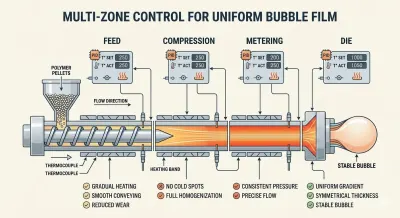
Our bubble film extrusion machines address this by dividing the extrusion process into independently controlled zones, each with its own PID-controlled heating bands and thermocouples, rather than treating the barrel as a single uniform space. The feed zone applies gradual heating that softens the polymer gently, which supports smooth solid conveying and encourages early melting without backflow. That gentler ramp also reduces both energy consumption and mechanical wear compared with pushing cold, solid pellets against aggressive heat too early in the process.
Moving into the compression zone, controlled temperature ramps work to fully homogenize the melt and eliminate the cold spots that are usually responsible for viscosity fluctuations later in the process. By the time material reaches the metering zone, the goal shifts from melting to maintaining, and precise control over melt temperature and pressure ensures a consistent, steady flow toward the die rather than a stream that varies in density or speed.
The die zone is where all of that upstream control actually becomes visible in the finished film. A uniform thermal gradient across the die lips produces symmetrical film thickness and stable bubble formation, and that stability holds even as line speed increases, which is often where less precise systems start to break down. Together, these four zones give the machine the ability to tailor a temperature profile to how the polymer actually behaves at each stage, rather than forcing one setting to work for every stage at once.
What Precise Zone Control Delivers in Practice
The benefits of this approach extend beyond just producing film that looks consistent. Stable bubble formation and even thickness translate directly into stronger tensile properties, better puncture resistance, and more reliable seal integrity, which matters as much for a protective industrial wrap as it does for a lightweight air-cushion pouch. Because each zone is only heating to the level the material actually needs at that stage, shear stress and material degradation are reduced as well, which helps preserve the mechanical properties the resin was chosen for in the first place.
There is also a real efficiency argument here. Precise zone-by-zone heating avoids the energy waste of overheating sections of the barrel that do not need it, and in practice this kind of control typically supports energy savings in the range of 20 percent compared with less precise single-zone setups. That efficiency holds across production speeds, whether the line is running slow for a specialized material trial or operating at full high-speed capacity for high-volume orders.
Built Into Every Layer of Our Machines
We treat multi-zone heating as a foundational feature of our bubble film extrusion machines rather than an add-on, because film quality is decided at the melting stage long before it reaches the die. Whether a customer is running a straightforward 2-layer line or a more demanding 7-layer structure combining barrier resins with standard LDPE and LLDPE, the same principle applies: each material stream needs its own temperature profile to melt and flow correctly, and getting that right is what allows the layers to bond properly and the finished film to perform consistently roll after roll.
This is also why our machines hold up well across air-cushion packaging, agricultural mulch film, and industrial protective wrap applications, since each of these end uses depends on a different balance of strength, flexibility, and barrier performance that only comes from a properly controlled melt. Reliable, low-maintenance operation follows naturally from that same precision, because a machine that is not fighting against uneven heating also puts less strain on its own components over time.
If your current line is producing film with inconsistent bubble height, drifting thickness, or weaker-than-expected mechanical performance, the root cause is often further upstream than it appears, in how temperature is being managed zone by zone rather than at the die alone. Our bubble film extrusion machines are built around independently controlled feed, compression, metering, and die zones specifically to close that gap, whether you are running a 2-layer, 3-5 layer, or 7-layer configuration. Our technical team can help you choose the right zone-control configuration based on your material requirements, production targets, and preferred bubble film machine setup.