Labor-Saving Automation: How to Operate a Bubble Film Extrusion Machine with Fewer Staff
2026-09-23
The packaging industry is facing increasing pressure from rising operating costs, labor shortages, and growing demands for higher production efficiency. As manufacturers continue to compete in global markets, reducing dependence on manual labor while maintaining stable product quality has become a critical goal. Traditional production methods that rely heavily on skilled operators are becoming more difficult to sustain due to higher labor expenses, longer training periods, and inconsistent production performance.
To overcome these challenges, manufacturers are increasingly turning to automated production technologies. A modern bubble film extrusion machine integrates intelligent control systems, precision sensors, and automated processing functions to simplify operation and improve overall productivity. With advanced automation, a small number of operators can manage complex production processes while achieving stable output, consistent quality, and reduced material waste.
Automation is no longer only an option for large packaging companies. It has become an important strategy for manufacturers seeking long-term competitiveness in the bubble film industry.
Industry Challenges of Traditional Bubble Film Production
Traditional bubble film manufacturing often depends on experienced operators to monitor and adjust key production parameters throughout the extrusion process. Factors such as screw speed, extrusion temperature, air pressure, cooling conditions, and winding tension must be controlled carefully to maintain stable film quality.
However, relying on manual adjustments creates several production challenges. Different operators may have different levels of experience, resulting in variations in operating methods and product consistency. Small mistakes in temperature control or material feeding can affect bubble formation, film thickness, and overall packaging performance.
Labor shortages have made these challenges even more significant. Many manufacturers struggle to recruit and retain skilled workers who understand complex extrusion processes. At the same time, labor costs continue to increase, making it difficult for companies to expand production capacity through additional manpower.
Manual production also increases material consumption during machine start-up, shutdown, and product changeovers. When operators need to adjust settings manually, more trial materials may be required before achieving the correct production condition. This not only increases raw material costs but also reduces production efficiency.
For modern packaging manufacturers, improving automation levels has become an effective solution to reduce operational pressure and create a more stable manufacturing environment.
The Growing Importance of Bubble Film in Modern Packaging
Bubble film has become an essential protective packaging material across many industries. From e-commerce logistics and warehouse transportation to electronics, furniture, automotive components, and fragile product protection, bubble film provides cushioning performance that helps reduce damage during handling and shipping.
With the rapid growth of global logistics, customers are demanding packaging materials with higher reliability and stronger performance. Manufacturers are required to produce bubble film with uniform thickness, stable bubble structure, excellent cushioning ability, and consistent roll quality.
Modern applications also require more advanced film structures. While traditional single-layer bubble film remains widely used, multi-layer solutions such as 2-layer, 3-layer, 5-layer, and 7-layer bubble film are becoming increasingly popular. Multi-layer extrusion technology allows manufacturers to optimize different layers for specific functions, including strength improvement, material savings, and the use of recycled materials.
For example, advanced multi-layer bubble film production can combine virgin materials with recycled content in selected layers while maintaining the required surface performance. This approach helps manufacturers reduce material costs and support more sustainable packaging production.
However, achieving stable multi-layer production requires precise control systems that are difficult to maintain through manual operation alone. This is where automated bubble film extrusion technology provides significant advantages.
How Our Bubble Film Extrusion Machine Reduces Labor Requirements
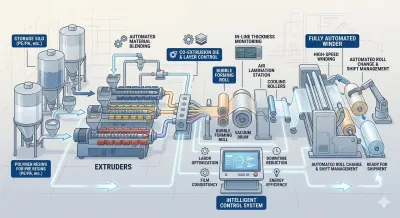
A modern bubble film extrusion machine is designed to simplify operation through intelligent automation and integrated control technology. Instead of requiring operators to constantly adjust machine parameters, automated systems can monitor production conditions and maintain stable operation throughout the manufacturing process.
The intelligent PLC control system functions as the central control unit of the production line. It manages important parameters including screw speed, heating temperature zones, extrusion pressure, cooling conditions, and winding tension. Operators can monitor the entire production process through an easy-to-use HMI interface, reducing the need for frequent manual adjustments.
Advanced recipe management functions allow operators to save optimized production settings for different bubble film specifications. When switching between products with different thicknesses, materials, or structures, the machine can quickly recall stored parameters. This reduces setup time and minimizes production errors caused by repeated manual adjustments.
The integration of closed-loop sensors further improves production stability. Online monitoring systems can continuously detect changes in film thickness, material flow, and production conditions. When a deviation occurs, the control system automatically adjusts relevant parameters to maintain consistent output.
This automated feedback process is especially valuable for multi-layer bubble film production, where several extrusion units must work together accurately. By maintaining precise synchronization between different layers, the machine helps achieve uniform film quality while reducing operator workload.
Automated Extrusion Process Improves Production Efficiency
The automation advantages of a bubble film extrusion machine extend beyond extrusion control. Modern production lines also include optimized winding systems, automatic tension control, and efficient cutting solutions to improve the final packaging process.
Automatic winding systems maintain stable roll formation by controlling winding speed and tension. This helps prevent problems such as loose rolls, uneven edges, or film wrinkles. As a result, finished bubble film rolls achieve better appearance and easier handling during storage and transportation.
Automatic cutting and material handling functions further reduce the need for manual intervention. Instead of assigning multiple workers to monitor different production stages, manufacturers can allow fewer operators to supervise the entire line.
For many factories, one trained operator can manage several automated production lines simultaneously. This “skeleton crew” operation model helps companies reduce labor dependence while maintaining high production capacity.
The benefits are not limited to labor savings. Automated control also improves material utilization by reducing unnecessary waste during startup, adjustment, and production changes. Precise temperature management and optimized extrusion conditions help lower energy consumption while maintaining stable product performance.
Improving Product Quality Through Intelligent Control
Quality consistency is one of the most important advantages of automated bubble film production. In manual production environments, even experienced operators may face challenges caused by changing materials, environmental conditions, or long operating hours.
Automation creates a more controlled production environment. Digital monitoring systems ensure that key parameters remain within the required range, helping manufacturers achieve stable bubble diameter, uniform film thickness, and consistent mechanical performance.
For industries such as electronics packaging and export logistics, consistent quality is especially important. Packaging failures can lead to product damage, customer complaints, and additional transportation costs. By improving process stability, automated extrusion equipment helps manufacturers deliver more reliable packaging solutions.
In addition, automation supports easier production management. Digital control records and production data allow manufacturers to analyze machine performance, optimize processes, and improve long-term operational efficiency.
Building a More Sustainable Packaging Production Future
Beyond reducing labor requirements, automation also supports more sustainable manufacturing practices. Precise control of extrusion parameters helps reduce excessive material consumption, while advanced multi-layer technology allows manufacturers to optimize raw material usage.
Many modern bubble film extrusion machines are designed to process different polyethylene materials, including LDPE, LLDPE, and recycled materials. With accurate feeding and temperature control, manufacturers can incorporate sustainable materials while maintaining product performance.
Energy-efficient components, optimized heating systems, and intelligent production management further contribute to lower operating costs and reduced environmental impact.
As packaging markets continue to evolve, manufacturers that invest in automated production technology will be better positioned to meet customer expectations for quality, efficiency, and sustainability.
Build a Smarter Packaging Future with an Automated Bubble Film Extrusion Machine
Automation has become a key solution for solving labor shortages, improving production efficiency, and maintaining consistent bubble film quality. A modern bubble film extrusion machine allows manufacturers to achieve high output with fewer operators by combining intelligent PLC control, automatic monitoring systems, precision extrusion technology, and optimized winding solutions.
With years of experience in packaging machinery development, we focus on providing reliable and efficient bubble film production solutions designed for modern manufacturing requirements. Our bubble film extrusion machine integrates advanced automation technology to help customers reduce labor dependence, improve production stability, optimize material usage, and achieve higher operational efficiency. By choosing our equipment, manufacturers can build smarter production lines and gain stronger competitiveness in the global packaging market.