Automated PLC Bubble Film Extrusion Machine: Reduce Labor Costs
2026-05-28
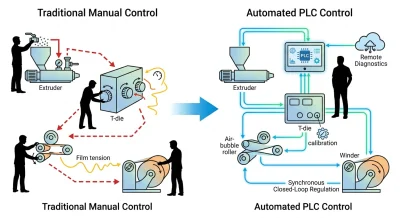
In the highly competitive packaging manufacturing sector, the pressure to control operational costs while meeting stringent product specifications is higher than ever. The advanced automated plc bubble film extrusion machine series directly addresses the industry's chronic bottleneck: an excessive dependency on manual labor. By replacing unpredictable manual adjustments with a synchronized closed-loop control architecture, this intelligent machinery guarantees consistent bubble gauge uniformity and melt stability across all production shifts.
Advanced PLC Automation vs. Traditional Line Vulnerabilities
Traditional bubble film extrusion lines require constant, highly skilled manual interventions to manage resin feeding, adjust T-die gaps, regulate tension, and synchronize winding speeds. These fragmented steps not only demand multiple operators per shift but also introduce human variability that compromises film quality.
The integrated PLC automation system eliminates these inefficiencies through a centralized, intelligent control network:
- Synchronous Closed-Loop Regulation: Continuously monitors and adjusts tension and melt distribution in real time, preventing film breakage and minimizing gauge variance.
- Intelligent Recipe Management: Stores precise processing parameters for various polymers, allowing operators to execute seamless material changeovers without manual recalibration.
- Integrated Ethernet/IP Diagnostics: Enables proactive system monitoring and remote troubleshooting, ensuring maximum uptime by identifying mechanical anomalies before they cause downtime.
Streamlined Technical Performance Across the Lineup
1. Multilayer Capability (2-Layer, 3–5-Layer, and 7-Layer Systems)
- 2-Layer Systems: Engineered for streamlined operations, these models reduce required operator interventions by 60%, effectively allowing a single technician to oversee multiple production units simultaneously.
- 3–5-Layer Systems: Utilizing an advanced digital recipe management system, these machines allow operators to switch between complex multi-layer material combinations in under 5 minutes, significantly slashing setup downtime.
- 7-Layer Systems: Representing the pinnacle of co-extrusion technology, these systems utilize intelligent melt distribution to secure perfect adhesion and structural integrity between all seven polymer layers.
2. Speed Configurations (Low, Medium, and High-Speed Extrusion)
- Low-Speed Operation: Focuses on maximizing operator efficiency and simplifying the startup process for short-run production batches.
- Medium-Speed Operation: Specifically designed for cost-conscious facilities, it incorporates energy-efficient heating and driving systems that cut power consumption by 15% per kilogram of extruded output.
- High-Speed Operation: Built for massive capacity demands, this configuration escalates production speeds up to 40 m/min and maintains a strict thickness tolerance within ±5 microns through automated winding synchronization.
Technical Impact on Operational Yield
Transitioning to an automated plc bubble film extrusion machine reshapes the economics of the factory floor through precise, data-driven manufacturing. Automating the critical stages of resin dosing and T-die distribution drives a 40% to 50% reduction in direct labor requirements. Furthermore, because the PLC system maintains a highly stable extrusion environment, raw material waste during startup and changeovers is minimized, ultimately delivering a measurable 20% improvement in total material yield.