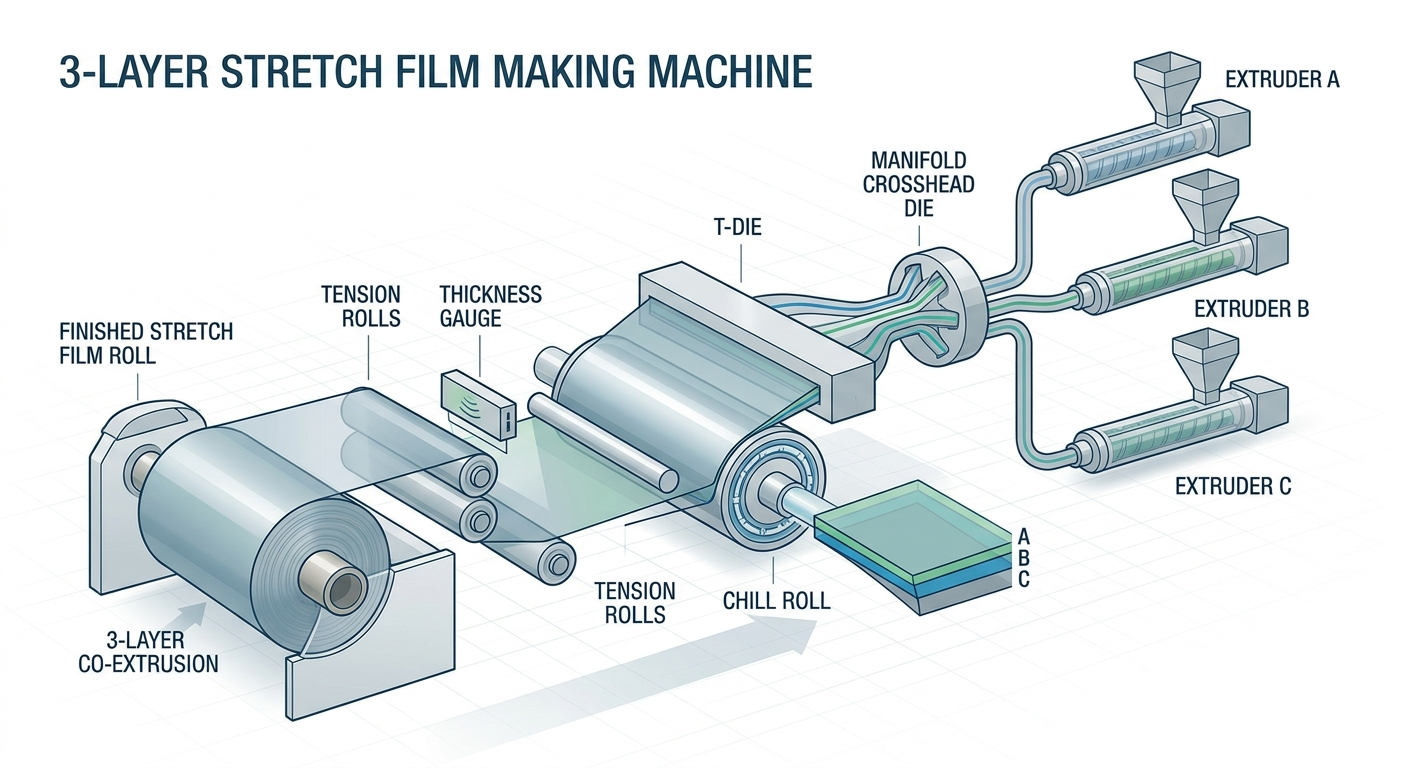
In industrial packaging, single-layer films often struggle to balance high stretchability with heavy-duty puncture resistance. The 3-layer stretch film making machine utilizes a precise A/B/C structural design to laminate polymers with different characteristics, fundamentally resolving the performance bottlenecks of single-material alternatives.
Core Architecture of the 3-Layer System
The co-extrusion technology within a 3-layer stretch film making machine relies on the synchronized operation of three independent extruders and a high-precision distribution system.
- Triple Independent Extrusion Units: Each 3-layer stretch film making machine is equipped with three separate single-screw extruders. This allows for the simultaneous processing of three distinct resin formulations—typically an adhesive-rich layer (A), a high-tenacity core (B), and a slip-enhanced outer layer (C).
- A/B/C Multi-Manifold Die: This is the critical hardware component. Three molten streams converge within a high-precision manifold. The internal flow channels are engineered to stack the polymers into a precise strata before they exit the die, ensuring zero disordered mixing between layers.
- Precision Thickness Control: The die system of the 3-layer stretch film making machine incorporates multi-stage heat sensors and automatic thermal bolts. These maintain constant melt viscosity across the entire web width, enabling precise control over layer ratios
Through the co-extrusion process, the 3-layer stretch film making machine produces a performance-engineered film where each layer serves a dedicated mechanical purpose:
- Layer A (Premium Cling): Formulated with high-concentration tackifiers, this layer provides superior self-adhesive properties to ensure the film bonds securely to the load.
- Layer B (Structural Core): Acting as the "skeleton," this layer provides the primary puncture resistance and high yield strength required for heavy or sharp-edged cargo.
- Layer C (Slip Surface): The outer layer is engineered for smoothness, preventing "pallet locking" during transport while protecting the load from dust and moisture.
Efficiency and Material Optimization
The structural approach of the 3-layer stretch film making machine provides significant technical advantages:
- Superior Elastic Recovery: The interaction between the three layers endows the film with high "memory," maintaining a persistent tightening force on the load during long-haul transit.
- Cost-Effective Down-Gauging: Due to the reinforced core, films from a 3-layer stretch film making machine achieve higher stability at a lower thickness, reducing material consumption by up to 20%.
- Functional Versatility: The machine allows for the isolated addition of UV stabilizers or anti-static agents within specific layers, maintaining mechanical integrity while reducing total additive costs.