In a modern stretch film making machine, the stability of film quality depends largely on one key factor: temperature control during independent melting and plasticization in each extrusion layer.
For 3-layer stretch film production, precise thermal management is the core technology that determines whether the film will have consistent strength, good clarity, and stable performance.
Independent temperature control in 3-layer extrusion
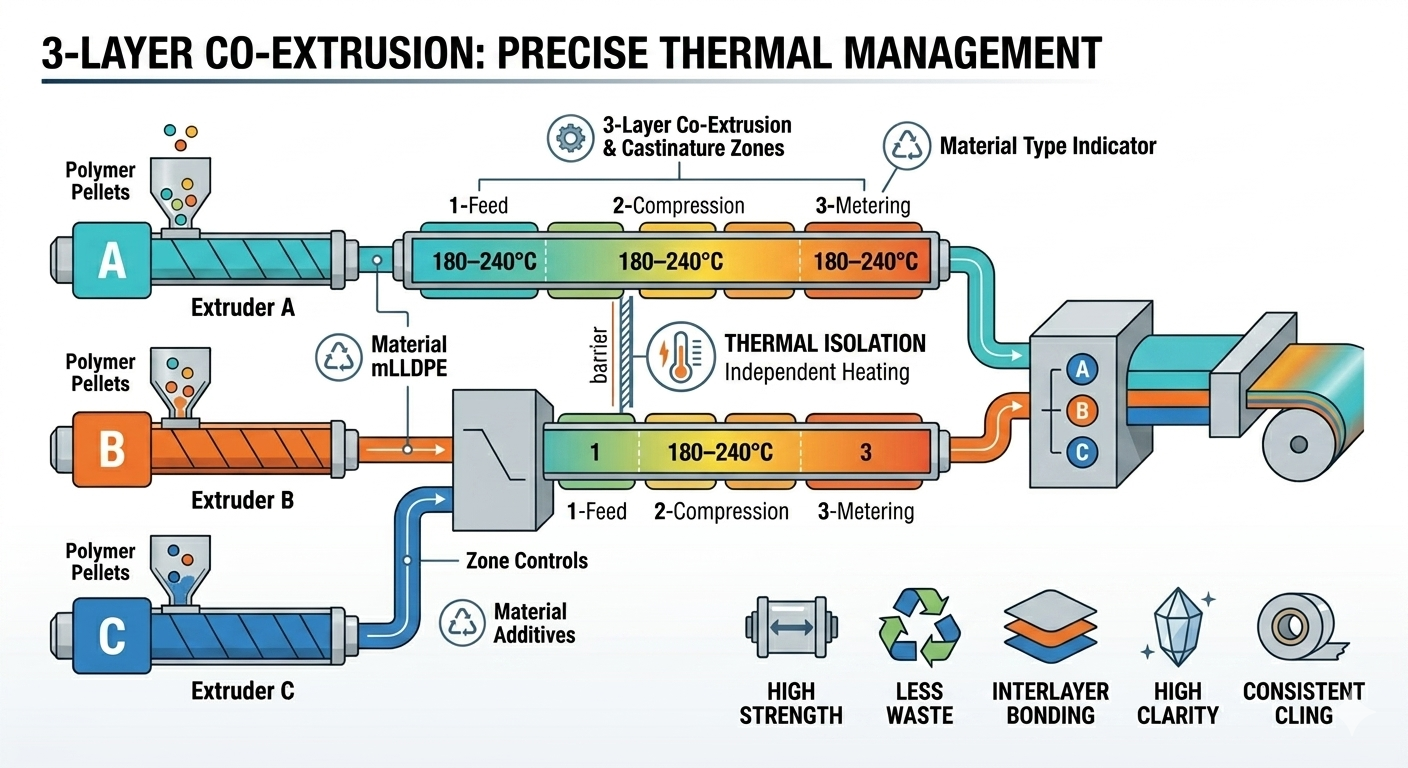
A 3-layer stretch film line uses three separate extruders, and each extruder has an independent heating system.
Typical temperature control characteristics include:
- Each layer operates in its own heating zones
- Temperature is adjusted independently for different polymer materials
- No thermal interference between layers
This structure ensures that every layer reaches its ideal melting state without affecting the others.
Typical processing temperature range (180–240°C)
In most stretch film making machine systems, the extrusion temperature is carefully maintained within 180–240°C, depending on material type:
- LLDPE: lower stable melting range for balanced flow
- mLLDPE: slightly higher temperature for improved strength
- Additives/tackifiers: controlled low-shear heating to prevent degradation
Precise control within this range is essential to avoid:
- Overheating and polymer breakdown
- Under-melting and poor film uniformity
- Viscosity instability during extrusion
Why temperature separation matters
Independent temperature zones in each extruder help achieve:
- Stable melt flow index (MFI) for each layer
- Consistent viscosity across the film structure
- Strong interlayer bonding without thermal damage
- Reduced risk of film breakage during production
By preventing cross-thermal influence, the machine maintains uniform plasticization quality throughout the entire production line.
Production benefits of precise temperature control
When temperature is accurately controlled in a 3-layer stretch film system, manufacturers gain:
- Higher film strength stability
- Reduced production waste
- Fewer line interruptions
- Better clarity and surface finish
- More consistent cling performance
This directly improves efficiency and lowers total production cost.
Conclusion
In a 3-layer stretch film making machine, independent and precise temperature control is the key to achieving high-quality film production.
By maintaining stable heating zones within the 180–240°C range and isolating each extruder thermally, manufacturers can ensure consistent melting behavior, stronger film structure, and reliable production performance.