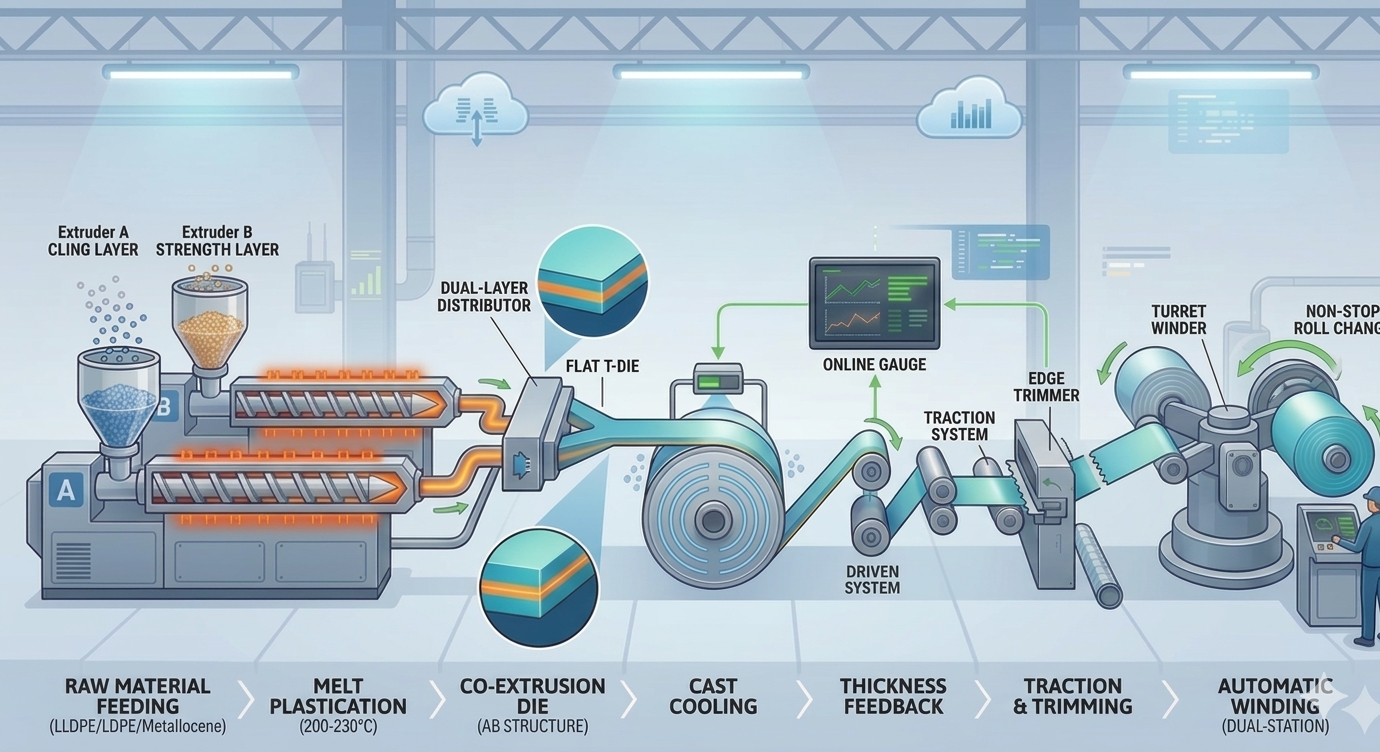
Achieving peak throughput in 2-layer (AB structure) stretch film production requires more than just raw mechanical speed. It demands a sophisticated synergy between thermal management, precise extrusion control, and seamless downstream automation. This guide analyzes the core technical drivers that enable manufacturers to sustain high-output operations while minimizing material waste.
1. Optimized AB Structure via Dual Extruders
The foundation of a 2-layer system lies in its dual-extruder configuration. By dedicating specific extruders to the "A" (cling/functional) and "B" (core/strength) layers, operators can optimize material flow rates independently.
Precision Melting: Independent temperature control for each extruder ensures that different resins (such as LLDPE or mLLDPE) reach their ideal viscosity without degradation.
Layer Ratio Control: Advanced feedblocks allow for precise layer distribution, ensuring the functional properties of the film are achieved with minimal raw material costs.
2. Rapid Quenching with Large-Diameter Chill Rolls
To achieve high-speed production, the molten polymer must be solidified almost instantaneously.
Thermal Exchange: The use of large-diameter chill rolls provides a greater surface contact area. This allows for faster heat dissipation, which is vital for maintaining film transparency and preventing crystallization at high linear speeds.
Surface Consistency: High-precision internal cooling circuits within the rolls ensure a uniform temperature profile across the entire web width, preventing gauge variations.
3. High-Speed Synchronization and Gauge Control
Modern lines rely on high-speed synchronization between the extruders, chill rolls, and haul-off units.
Online Thickness Feedback: Integrating an automatic T-die with a non-contact thickness gauge (using infrared or X-ray sensors) allows for real-time adjustments. This "closed-loop" system minimizes the "heavy edges" and ensures the film stays within tight tolerances.
Vibration Mitigation: Mechanical stability at high RPMs is crucial to prevent gauge bands and ensure consistent film stretchability.
4. Automatic Turret Winding for Non-Stop Operation
The final stage of an efficient line is the transition from the web to the finished roll.
Automatic Turret Winders: These systems enable non-stop operation by automatically indexing and cutting the film once a roll reaches its set diameter or length.
Waste Reduction: High-speed flying knives and precision tension control during the "flip-over" process minimize scrap during roll changes.
Consistent Roll Profile: Taper tension control ensures that the inner layers of the roll aren't crushed, while the outer layers remain secure for transport.
Conclusion
Maximizing efficiency in 2-layer stretch film production requires a synergy of advanced extrusion hardware and intelligent automation. By focusing on rapid quenching, precise thickness feedback, and automated winding, manufacturers can achieve maximum output with minimal waste, ensuring a high ROI in a demanding market.