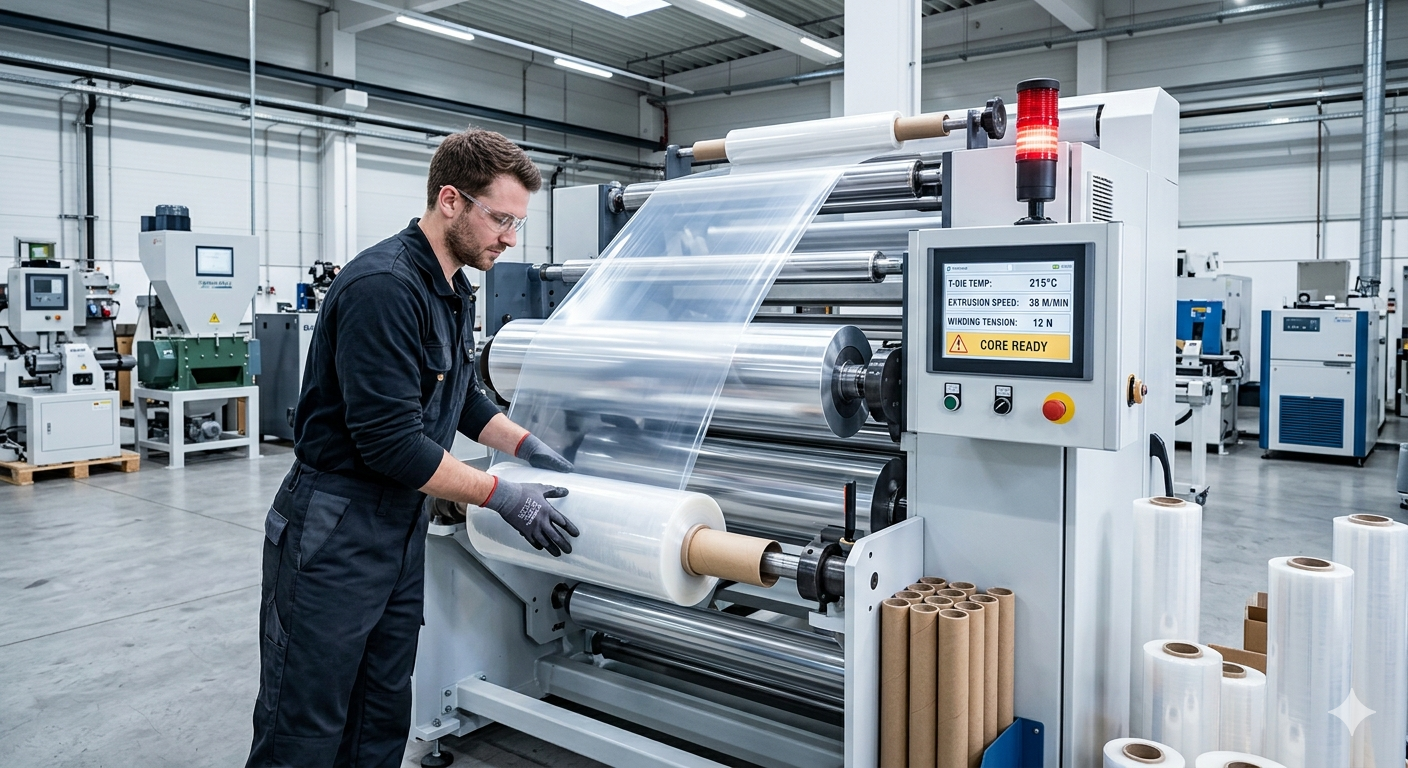
Operational Tips for Semi-Auto Stretch Film Extrusion Machine
To achieve consistent, high-quality output and maximize the lifespan of a semi-automatic stretch film extrusion machine, precise operational discipline is essential. Following these technical guidelines ensures stable production, reduces material waste, and maintains superior film properties.
1. Precision Thermal Management
Stable extrusion temperature is the foundation of high-quality film.
- Temperature Windows: Maintain the polymer melt temperature strictly within the 200-230°C range. Fluctuations outside this window can lead to inconsistent resin flow and compromised tensile strength.
- Pre-heating Phase: Ensure extruders reach the target temperature and stabilize for at least 30 minutes before starting production. This prevents unmelted LLDPE resin from damaging the screw.
- 2. Cooling System & Chill Roll Maintenance
- Rapid and uniform cooling (quenching) determines the film's clarity and gauge consistency.
- Daily Cleaning: Clean the chill roll surface daily. Even microscopic contaminants can cause scratches, "gels," or localized thickness variations.
- Internal Circuit Check: Regularly inspect the internal water-cooling circuit to ensure a stable flow rate and constant temperature across the roll width.
- 3. T-Die Alignment & Calibration
- The T-die is critical for achieving a uniform film gauge.
- Regular Alignment: Periodically check the T-die alignment and the gap between the die lips. Even minor misalignments result in gauge variation (thickness inconsistency).
- Purging Protocols: Use professional purging compounds during material changes or shutdowns to prevent carbonization inside the die.
- 4. Winding Tension & Core Change Safety
- The winding stage defines the final product's roll integrity and usability.
- Tension Monitoring: Continuously monitor the winding tension through the HMI. Improper tension causes "telescoping" rolls or film deformation.
- Manual Core Change Safety: Utilize the machine's integrated alarm system. Operators must ensure the cutting device is reset before initiating a manual paper core change.
- Ergonomic Loading: Proper core positioning at the winding station prevents edge defects and ensures a smooth start for the next roll.
- 5. Systematic Maintenance for Maximum Uptime
- Lubrication: Follow a strict schedule for lubricating chains, bearings, and sliding parts to minimize friction and wear.
- Sensor Calibration: Keep optical sensors and meter counters clean and calibrated to ensure precise roll lengths and error-free operation.