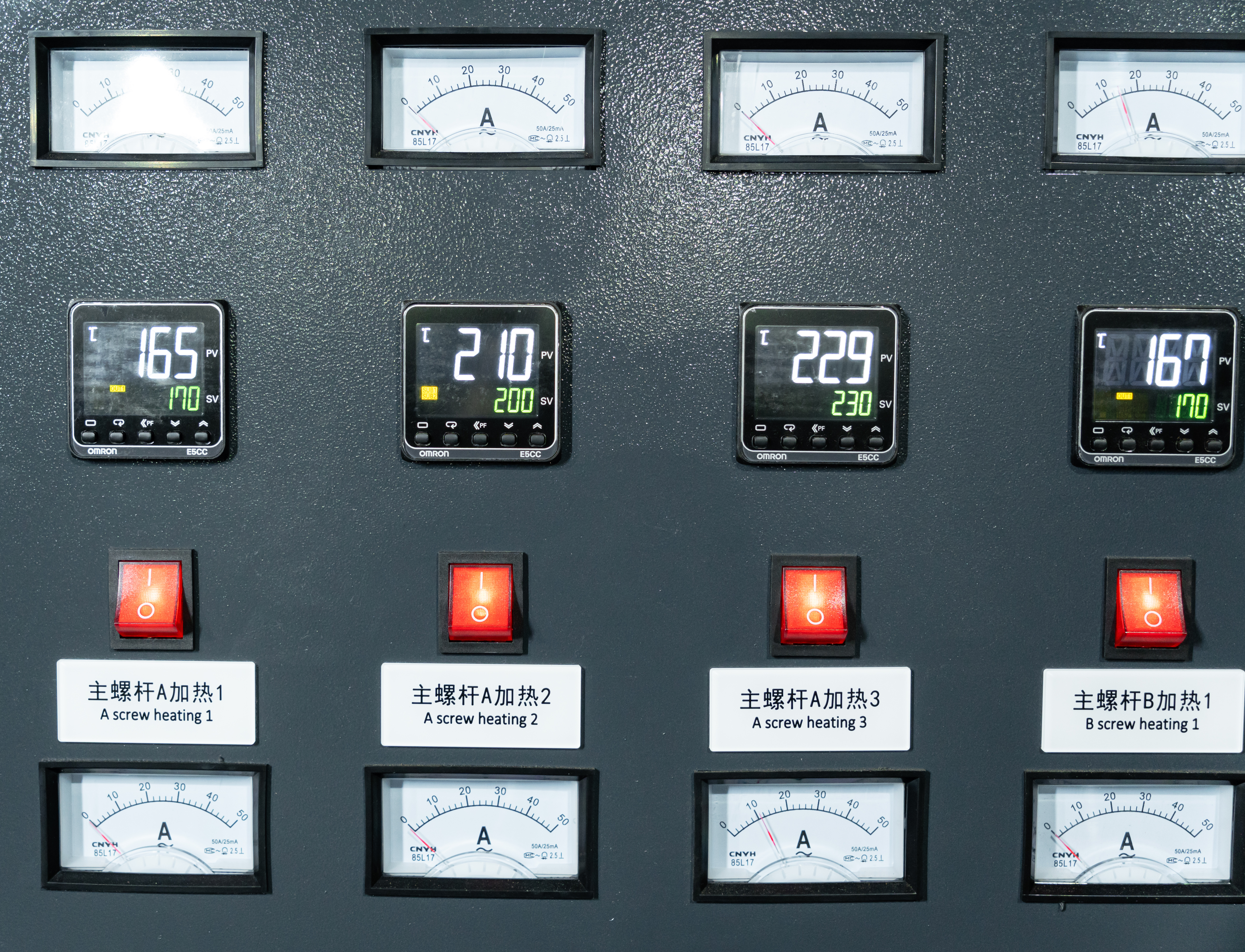
The power supply is a fundamental determinant of performance and reliability in multi-layer stretch film machines, including 2-layer, 3-layer, and 5-layer models. These machines require precise and stable power to maintain uniform torque across all winding stations, consistent film tension, and reliable layer adhesion. Any fluctuation in voltage, phase balance, or frequency can directly affect extrusion stability, film thickness uniformity, and multi-layer bonding.
Our machines are designed to operate on a 380V, 3-phase, 4-wire, 50Hz power system, and each of these specifications plays a critical role in ensuring production quality. The 380V nominal voltage provides sufficient electrical potential to drive high-torque extrusion screws, servo motors, and heating elements simultaneously. This voltage level supports stable extrusion and consistent pre-stretching, enabling uniform thickness and strong mechanical properties across all film layers. Operating below this voltage can result in reduced torque, slower motor response, and uneven layer formation, while higher-than-specified voltage risks overloading motors and shortening component life.
The 3-phase configuration is essential for balanced power distribution across multiple winding and extrusion stations. Each phase delivers energy evenly, preventing torque fluctuations that often occur in single-phase systems during layer transitions. Torque instability can lead to uneven film tension, weak adhesion between layers, and defects such as edge tearing or delamination. By maintaining phase balance, the system ensures that all layers are extruded and wound under uniform force, which is especially important in multi-layer co-extrusion where each layer’s integrity depends on precise tension control.
The 4-wire setup, including a dedicated neutral and grounding conductor, protects sensitive electronic components, PLC controllers, servo drives, and heating elements from voltage spikes, leakage currents, and transient surges. This is critical for 24/7 industrial operation, where uncontrolled voltage fluctuations can lead to unexpected stops, motor overheating, or premature component failure. Grounding also reduces electromagnetic interference (EMI) that can affect control signals, ensuring that sensors, torque monitors, and automated tension control systems function reliably.
Maintaining a stable 50Hz frequency is equally important. Frequency stabilization modules ensure that motors operate at precise speeds, preventing over- or under-speed conditions that can compromise extrusion uniformity and layer adhesion. Consistent frequency reduces harmonic distortion, motor vibration, and heating, which helps preserve mechanical components and maintain precise pre-stretch ratios. In regions with unstable electrical grids, frequency control prevents production variability, maintaining ±0.5% film thickness tolerance even under fluctuating supply conditions.
Together, the 380V, 3-phase, 4-wire, 50Hz configuration provides the operational foundation for multi-layer stretch film machines. Stable voltage, balanced phases, dedicated grounding, and frequency control collectively ensure uniform torque, consistent film tension, and reliable multi-layer adhesion. They also improve machine longevity by reducing wear on servo motors, heaters, and control electronics, while minimizing downtime and maintenance costs. Properly engineered power integration directly impacts the quality of the finished film, enabling consistent puncture resistance, tensile strength, and cling properties necessary for industrial packaging and transportation applications.
In conclusion, the power supply system is not merely a technical requirement—it is the backbone of machine performance. For multi-layer stretch film production, ensuring correct voltage, phase balance, grounding, and frequency stability is essential to achieve uniform film properties, precise tension control, and long-term operational reliability, supporting high-efficiency packaging and transport operations across a wide range of industrial applications.