Independent Thermal Management for AB Layers
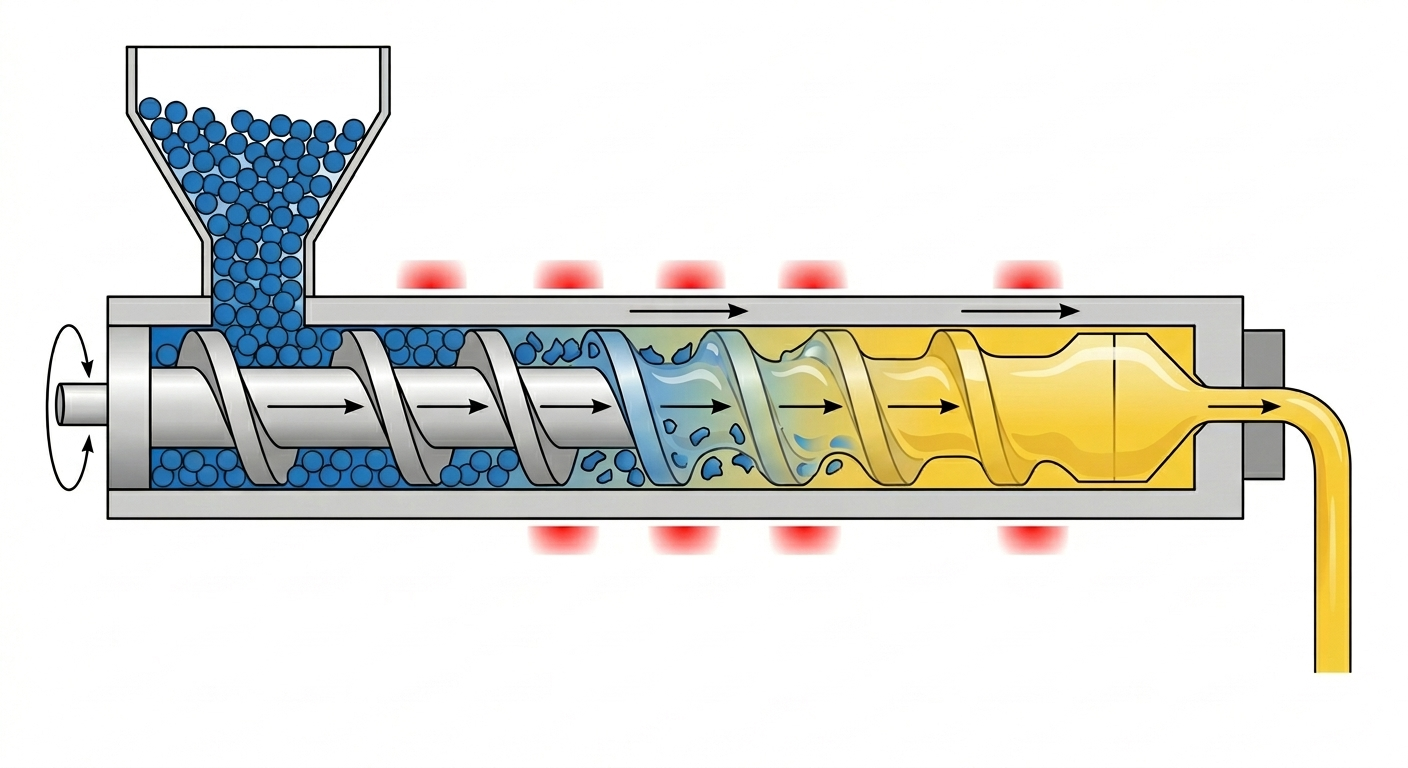
The core of our 2-layer co-extrusion technology is independent thermal sovereignty for each material stream. Each extruder features dedicated, high-precision temperature control zones. By heating specific resin blends to their ideal processing window of 200°C to 230°C, the system ensures optimal melt viscosity and molecular relaxation before the layering process.
Advanced Plasticization and Homogenization
Precise thermal governance is critical for achieving consistent polymer flow:
- Targeted Heat Profiles: Individual extruders allow different resins, such as LLDPE or Metallocene, to reach their specific melting points without thermal degradation.
- Melt Homogenization: High-performance screw designs provide uniform shear, transforming solid pellets into a homogenized melt with stable viscosity.
- Elimination of Defects: Precision control reduces gel formation and carbonization, ensuring maximum film clarity and gloss across high-speed production cycles.
- Superior Molecular Bonding and Interfacial Integrity
- Mastering the plasticization phase establishes the foundation for a monolithic AB film structure:
- Interfacial Entanglement: Optimal melt states allow polymer chains to inter-diffuse effectively at the interface, preventing delamination under extreme mechanical stress.
- Structural Integrity: The resulting AB structure offers unparalleled puncture resistance and consistent cling force, maintaining load stability even in challenging environments.
- Gauge Uniformity: Precise thermal management leads to stable melt pressure, which is essential for maintaining strict thickness tolerances and reducing material waste.
- Technical Versatility and Stability
- This precision extrusion system provides the flexibility needed for modern material science:
- Resin Flexibility: The machine easily adapts to a wide range of resin grades, including high-performance additives and recycled content.
- Operational Consistency: Advanced sensors provide real-time feedback, ensuring that the 200–230°C melt state remains constant throughout long-distance production runs.
- Industrial-Grade Output: The synergy between thermal control and mechanical shear guarantees high-performance industrial stretch films with batch-to-batch uniformity.