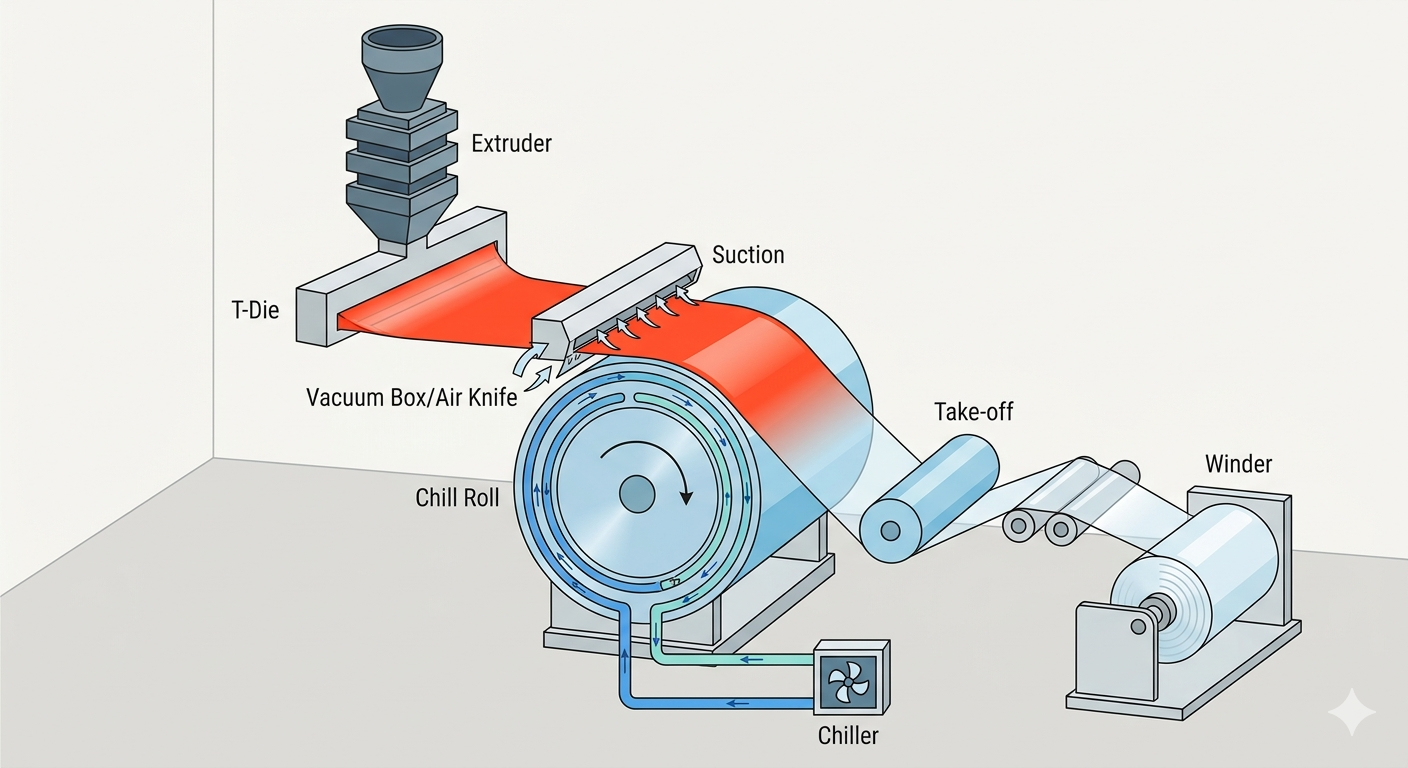
In the production of high-quality stretch film, the transition from molten resin to a solid, high-performance web is the most critical stage. For 2-layer stretch film machines, this is achieved through a precision-engineered cast cooling process.
By rapidly quenching the polymer, manufacturers can achieve the superior clarity and mechanical strength required for industrial packaging. Here is a technical breakdown of how this process works.
1. The Interaction: T-Die to Chill Roll
The process begins as the molten resin is extruded through a flat T-die. As the molten "curtain" exits the die, it immediately makes contact with a large-diameter chill roll.
The goal is to move heat away from the polymer as quickly as possible. In a 2-layer setup, where different resins (such as LLDPE and tackifiers) may be used in each layer, the chill roll ensures both layers solidify simultaneously into a cohesive structure.
2. Rapid Quenching and Crystallization Control
The core objective of cast cooling is rapid quenching.
- Clarity: By cooling the film instantly, the process prevents the formation of large polymer crystals (spherulites). Smaller crystal structures result in the high optical clarity and gloss that stretch films are known for.
- Mechanical Properties: Proper crystallization control directly impacts the film's stretchability, tensile strength, and puncture resistance.
- 3. Internal Water Circulation
- To maintain a constant, low temperature, the chill roll utilizes a sophisticated internal water circulation system. Cold water is pumped through internal channels or a double-shell spiral design within the roll. This ensures that the surface temperature remains uniform across the entire width of the roll, preventing "hot spots" that could lead to uneven film gauge.
- 4. Vacuum Pinning for Uniformity
- A common challenge in high-speed casting is the "air pocket" that can form between the molten film and the roll. To solve this, 2-layer machines often employ vacuum pinning (via a vacuum box).
- The vacuum box removes the air film at the point of contact.
- This forces the molten resin to "pin" tightly against the polished surface of the chill roll.
- Result: Improved thickness uniformity and enhanced heat transfer efficiency.
- 5. Achieving Superior Film Quality
- By integrating these technologies, the cast cooling process ensures that the final 2-layer stretch film meets strict industrial standards. The combination of a high-precision chill roll and controlled pinning results in a product with consistent clinching properties and reliable performance in high-speed automated wrapping applications.