Why Global Distributors Prefer China-Made Bubble Film Extrusion Machine
2026-05-19
In the high-volume protective packaging market, manufacturing consistent, cost-effective bubble film requires advanced engineering. Legacy single-layer and outdated multi-layer systems frequently suffer from gauge variation, poor barrier properties, and high energy draw.
Modern Chinese bubble film extrusion machines solve these technical bottlenecks. By integrating advanced co-extrusion technology, multi-point thickness automation, and energy-saving drives, these systems deliver high-speed, scalable output across diverse material specifications.
Comprehensive Portfolio for Targeted Production
The standard product lineup accommodates varied output requirements and layer configurations:
- 7-Layer High-Speed Bubble Film Machine: Designed for high-quality bubble film, providing high-barrier properties for applications that require specific oxygen and moisture transmission rates.
- 3–5-Layer High-Speed Bubble Film Machine: Engineered for high-throughput, multi-layer standard film production.
- 3–5-Layer Medium-Speed Bubble Film Machine: Balances consistent output with precise technical control.
- 3–5-Layer Low-Speed Bubble Film Machine: Optimized for specialized, lower-volume technical runs.
- 2-Layer High-Speed Bubble Film Machine: Delivers rapid processing for standard, cost-efficient cushioning films.
- 2-Layer Medium-Speed Bubble Film Machine: Ideal for stable, mid-range standard film manufacturing.
- 2-Layer Low-Speed Bubble Film Machine: Entry-level configuration for basic two-layer protective film.
Technical Features and Engineering Advantages
Precision Thickness Control and Gauge Uniformity
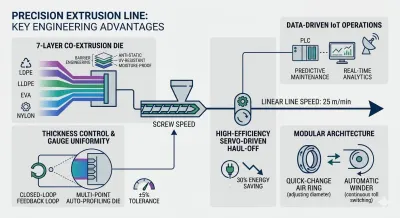
Maintaining consistent film thickness is critical for bubble structural integrity. These modern extrusion lines integrate multi-point auto-profiling die heads alongside a closed-loop screw speed feedback loop. This technical setup actively monitors production parameters, keeping bubble height and film gauge variations within an exact tolerance of ±5%. This prevents thin spots, ensuring uniform impact resistance across the entire film roll.
Advanced Multi-Layer Co-Extrusion and Barrier Engineering
For high-barrier or technical packaging, the 7-layer high-speed variant can process seven distinct material layers in a single pass. It co-extrudes materials including LDPE, LLDPE, EVA, and Nylon. This enables precise control over barrier properties, such as anti-static, UV-resistant, or moisture-proof capabilities, while maintaining continuous linear line speeds of 25 meters per minute.
Servo-Driven Energy Efficiency
Power consumption directly affects total cost of ownership. These machines utilize energy-saving screw profiles paired with high-efficiency servo-driven haul-off units. Replacing conventional hydraulic drives with full servo systems reduces total electrical energy consumption by up to 30%, optimizing thermodynamic efficiency during continuous extrusion.
Modular Flexibility and Automation
The machinery utilizes modular architectures to support fast product changeovers. Integrated configurations can include:
- Quick-Change Air Rings: Optimizes cooling dynamics for different bubble diameters.
- Automatic Winders: Enables continuous, tension-controlled roll switching without line stoppage.
Data-Driven IoT Operations
Equipped with IoT-ready programmable logic controllers (PLCs) and remote monitoring modules, these extrusion lines output real-time performance analytics. Predictive maintenance tracking, temperature zone monitoring, and automated fault diagnostics minimize unexpected downtime and streamline maintenance scheduling.