
News
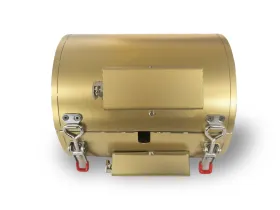
Advantages of Infrared Heating Systems Over Conventional Heating Coils
The infrared heating system improves thermal efficiency by 40% and reduces energy consumption by 20%, offering faster and more effective heating performance. In contrast, conventional heating coils suffer from slow heat-up, poor insulation, and higher power consumption, resulting in lower efficiency and increased operational energy costs.
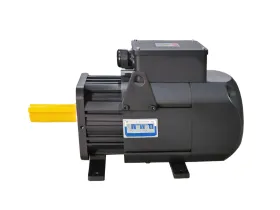
Differences Between Permanent Magnet Synchronous Motors and Asynchronous Motors
In today's industrial landscape, choosing between a Permanent Magnet Synchronous Motor (PMSM) and a traditional Asynchronous Motor is a critical decision impacting efficiency, precision, and long-term operational costs. While both have their place, the advanced PMSM technology offers compelling advantages for applications demanding high performance...
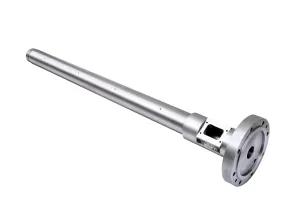
Advantages of Thick-Walled Barrel and Screw Design for Temperature Control
Thick-walled barrel and screw design improves thermal retention, reducing energy consumption by 15–20% and maintaining stable melt temperatures within ±5°C for consistent film quality. In contrast, thin-walled barrels lose heat quickly, increasing energy waste by 25–30%, while temperature fluctuations cause uneven melting and significant thickness variations up to ±10%.
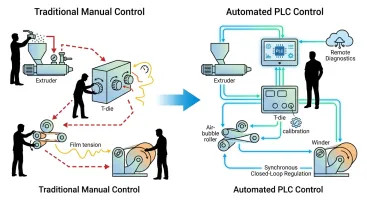
Automated PLC Bubble Film Extrusion Machine: Reduce Labor Costs
As global competition intensifies, packaging manufacturers face mounting pressure to cut production costs while maintaining stringent quality standards. The latest Automated PLC Bubble F…
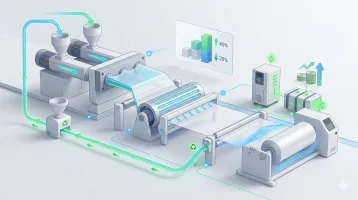
Stretch Film Extrusion Machine ROI: How to Achieve Fast Production & Profits
Optimizing stretch film extrusion ROI requires advanced co-extrusion technology paired with automatic high-speed rewinding, leveraging specialized LLDPE screw designs for high-efficiency, homogenous output. Integrating online recycling systems ensures 100% edge-trim recovery, minimizing material waste and downtime to accelerate profitability...
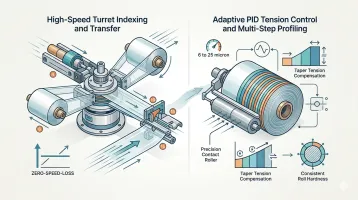
Stop Stopping Your Stretch Film Extrusion Machine: Eliminate Winding Downtime
Continuous stretch film extrusion requires uninterrupted winding transitions. Minor roll-change delays disrupt gauge consistency, cause polymer degradation in the die, and create massive scrap…
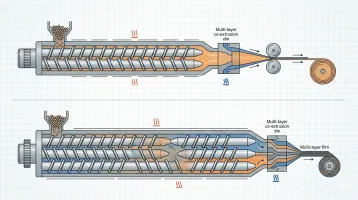
Twin vs Triple Screw: Which Stretch Film Extrusion Machine to Choose?
In the competitive stretch film market, choosing between twin-screw and triple-screw extrusion technology is a critical decision that directly impacts production efficiency, film quality, and long-term profitability. This in-depth report examines the technical distinctions, application scenarios, and economic considerations of 2-Layer, 3-Layer, and 5-Layer Stretch Film Machines, along with Fully Automatic and Semi-Automatic configurations. Whether you produce standard LLDPE wraps or multi-layer premium performance films, understanding the screw architecture is essential for optimizing your capital investment and operational output.
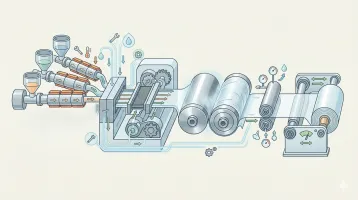
Stretch Film Machine Holiday Shutdown & Maintenance Guide
When production pauses for extended holidays, stretch film extrusion lines face acute risks of polymer degradation, carbonization, and rust damage. This guide details the essential maintenance sequence for Semi-Automatic, Fully Automatic, 2-Layer, 3-Layer, and 5-Layer Stretch Film Machines…
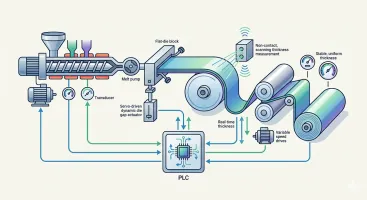
Automated Gauge Control: How PLC Reduces Variation in Bubble Film Extrusion Machines
In the high-stakes world of bubble film production, even minor thickness variation can cascade into structural weakness, material waste, and output rejections. This article explores how PLC-based automated gauge control systems in 7-Layer High-Speed Bubble Film Machines, 3–5-Layer Low-Speed Bubble Film Machines, and related models deliver real-time correction, stable bubbles, and consistent film quality at production speeds.
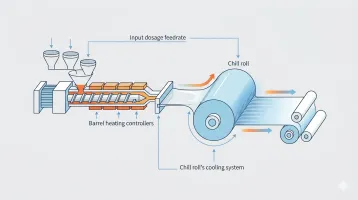
Stretch Film Losing Cling? Troubleshooting Guide for Extrusion Machines
Poor cling in stretch film extrusion often stems from insufficient PIB dosage, excessive melt temperature, or unstable cooling. This guide for 2, 3, and 5-layer machines offers precise solutions to restore adhesion and load stability.