
News
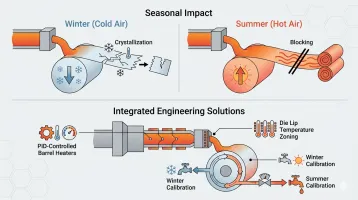
How Temperature Affects Stretch Film Extrusion Machines & Seasonal Adjustments
Ambient temperature shifts challenge stretch film extrusion quality. Learn how Semi-Automatic, Fully Automatic, 5-Layer, 3-Layer, and 2-Layer Stretch Fi
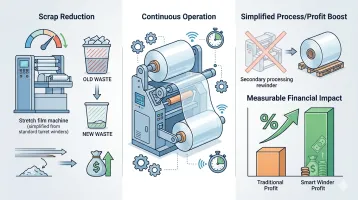
How Smart Winders on Stretch Film Extrusion Machines Boost Net Profit
Stretch film manufacturers often face profit erosion due to film telescoping, wrinkles, and excessive edge scrap during winding. Smart winders equipped with closed-loop tension control and dynamic edge-encapsulation on Semi-Automatic, Fully Automatic, 2-layer, 3-layer, and 5-layer Stretch Film Machines eliminate these issues, ensuring uniform roll geometry and reducing material waste by up to 15%. Non-stop roll changes further enhance throughput, directly boosting net profit margins across high-speed production lines.

ROI of Upgrading to High-Speed Multi-Layer Stretch Film Extrusion Machines
Upgrading to high-speed multi-layer stretch film extrusion machines delivers measurable ROI through accelerated throughput, precision co-extrusion for downgauging, and advanced automation that reduces resin consumption and operational costs.
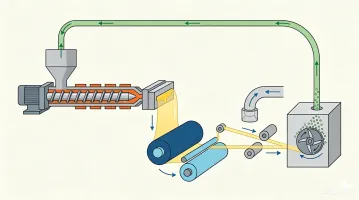
How Stretch Film Edge Trim Recycling Systems Boost Your Profit Margins
In the competitive stretch film manufacturing landscape, material waste has long been a silent profit killer. Modern 5-Layer Stretch Film Machine, 2-Layer Stretch Film Machine, and 3-Layer Stretch Film Machine now integrate inline edge trim recycling systems that recover LLDPE scrap and automatically r
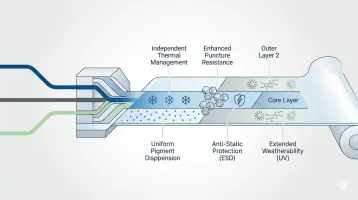
Custom Stretch Film Extrusion Machines for Niche Markets: Colored, Anti-Static & UV Resistant
Specialty packaging demands more than standard stretch film. For distributors serving electronics, aerospace, or outdoor logistics, conventional films fall short. The solution lies in advanced multi-layer co-extrusion technology—2-layer, 3-layer, and 5-layer stretch film machines engineered for precise additive integration. This report explores how these systems deliver colored, anti-static, and UV-resistant films with uncompromised mechanical performance.
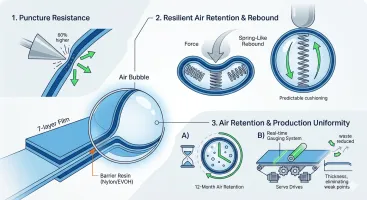
How Multi-Layer Bubble Film Extrusion Machines Enhance Cushioning Protection
In the high-stakes world of B2B logistics, inconsistent bubble film performance remains a critical pain point. Our multi-layer extrusion technology—from 2-Layer Low-Speed to 7-Layer High-Speed machines...
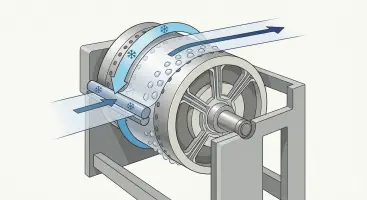
Deconstructing the Mechanical Design of High-Efficiency Bubble Film Extrusion Machines
Precision engineering is the backbone of high-output bubble film production. This report dissects how twin-screw extruders, precision T-dies, vacuum forming rollers, and PLC-driven systems in 3–5-layer and 7-layer machines solve common bottlenecks in thickness uniformity, thermal stability, and energy efficiency.
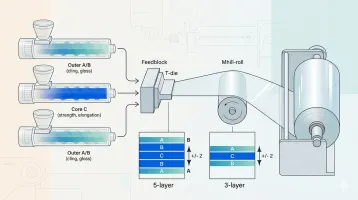
Structural and Technical Analysis of Multi-layer Stretch Film Extrusion Machines
Modern stretch film production demands flawless load containment, material economy, and high-speed output. Multi-layer extrusion machines—2-layer, 3-layer, and 5-layer configurations—integrate multiple extruders, feedblocks, precision T-dies, and automatic winding units to address these challenges. This technical analysis explores the structural advantages of Fully Automatic and Semi-Automatic systems, highlighting how co-extrusion architectures, PLC-controlled melt pumps, and online gauging deliver superior tensile strength, puncture resistance, and thickness uniformity while reducing resin waste.
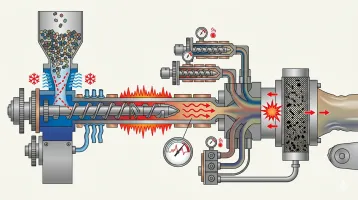
Causes and Quick Fixes for Output Pulsing in a Stretch Film Extrusion Machines
Output pulsing in stretch film extrusion machines disrupts film gauge uniformity and production yield. This technical report examines the primary causes—unstable solid conveying, non-uniform barrel temperatures, and clogged screen packs—and details quick fixes applicable to 2-layer, 3-layer, 5-layer, semi-automatic, and fully automatic stretch film machines.
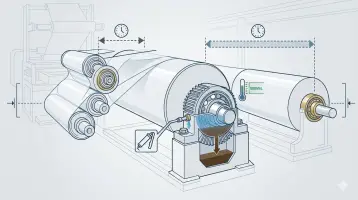
Warning Signs of Overheating Bearings & Lubrication Checklist for a Stretch Film Extrusion Machines
Overheating bearings in stretch film extrusion machines often show warning signs such as abnormal vibration, rising housing temperature, burnt grease odor, noise, and lubricant discoloration. A preventive lubrication checklist should include correct grease selection, scheduled relubrication, contamination control, seal inspection, alignment verification, and monitoring bearing temperatures to avoid premature failure.