
Technical Encyclopedia
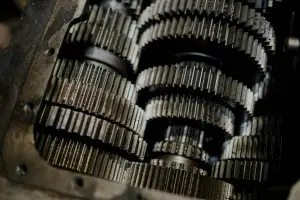
Key Factors Affecting Air Bubble Film Machine Production Speed
As a bubble film manufacturer, maximizing your production line's output is crucial. This in-depth technical analysis explains the four critical factors—extrusion capacity, cooling efficiency, material rheology, and automation—that dictate your machine's speed. Learn how advanced screw design, powerful vacuum systems, and perfect synchronization unlock higher yields and a better return on investment...
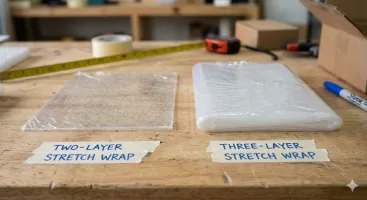
Comparison Between 2-Layer and 3-Layer Stretch Film
Discover the game-changing evolution in pallet wrapping technology. Our in-depth technical comparison reveals how advanced 3-layer "ABC" co-extrusion delivers 30–50% stronger puncture resistance and 300–400% stretch capability, while reducing raw material costs by 15–20% compared to conventional 2-layer films. This breakthrough...
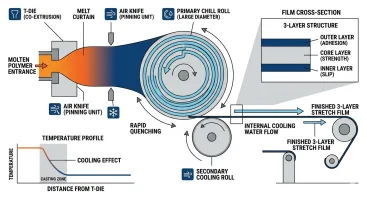
Casting and Cooling Process of 3-Layer Stretch Film Making Machine
The casting and cooling process is the critical heart of 3-layer stretch film production. Inconsistent cooling leads to weak, hazy films with poor stretch recoil, increasing waste and c...
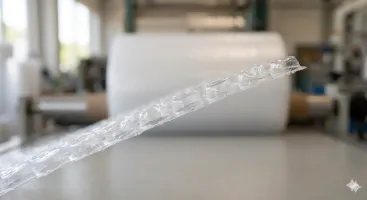
How Internal Heating Die Design Improves Thickness Accuracy in Bubble Film Extrusion
Discover how our proprietary internal heating die design eliminates edge cooling defects by embedding heat sources directly within the melt flow. This breakthrough ensures perfect temperature distribution across the entire die width...
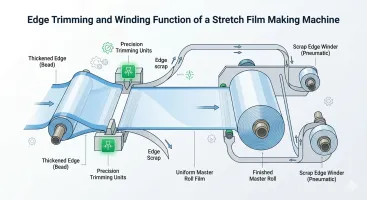
Edge Trimming and Winding Function of Stretch Film Making Machine
For industrial stretch film production, inconsistent edge quality is a silent killer of profitability. It leads to waste, machine downtime, and unreliable final products. The integrated Edge Trimming and Winding function...
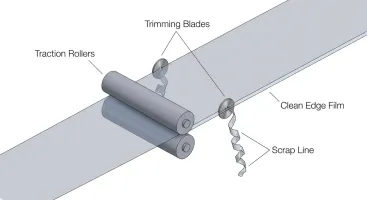
Maximizing Film Stability: Traction and Edge Trimming in 2-Layer Stretch Film Machines
Inconsistent tension and poor edge quality are the primary culprits behind production downtime and film waste in 2-layer stretch film manufacturing. The integration of advanced traction control and high-precision trimming is not merely an improvement—it's a complete overhaul of core stability...
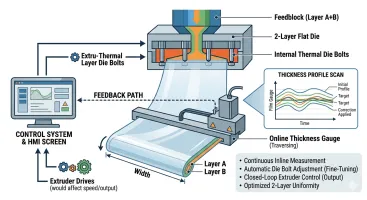
How to Achieve Precise Thickness Control in 2-Layer Stretch Film Machines
Discover how online thickness gauge technology and closed-loop control systems in 2-layer stretch film machines eliminate gauge variation, optimize material usage, and ensure superior film uniformity for maximum production ROI...

Pros and Cons of Using Eco-friendly Materials in Bubble Film Making Machine
Incorporating recycled PCR or bio-resins into bubble film production presents a key sustainability challenge: a narrowed processing window. This technical analysis explores how advanced extruder control and filtration in our 2-7 layer machines ensure structural integrity and consistent performance, turning material complexity into a competitive edge for demanding packaging sectors like electronics and fresh food...
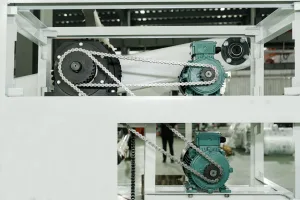
Why Worm Gear Drives Last Longer: The Science Behind Enhanced Durability
Worm gear drives offer superior longevity through their unique sliding contact design, which distributes loads over a larger surface area compared to point-contact gears. This reduces localized stress and wear. Their robust, self-locking structure also absorbs mechanical shocks better than belts, ensuring stable, long-term performance in demanding extrusion environments.
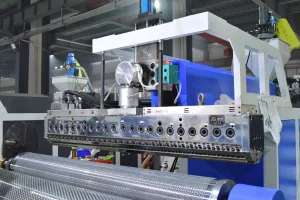
T-Die for Bubble Film Manufacturing Machine
Explore how our advanced T-Die technology ensures unparalleled uniformity and thickness control in bubble film production. Discover the engineering excellence behind consistent, high-quality film output for your protective packaging needs...