
News
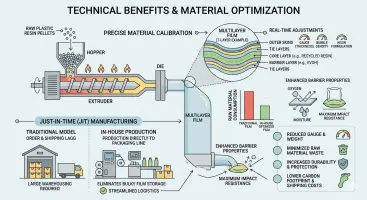
The Economic Advantage of In-house Production Using a Bubble Film Extrusion Machine
For businesses reliant on protective packaging, the traditional model of procuring bubble film presents significant challenges: volatile pricing, extended lead times...
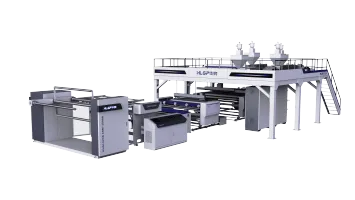
Operating Precautions for 3–5 Layer Medium-Speed Bubble Film Machines in Industrial Production
Mastering key operational precautions for multi-layer bubble film machinery ensures production efficiency, product consistency, and equipment longevity. This guide details essential practices from startup to shutdown for optimal performance...
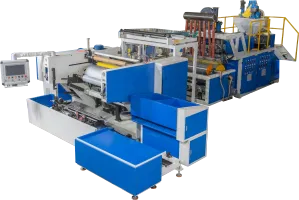
Key Advantages of 2-Layer Co-Extrusion Stretch Film Machines
This high-performance 2-layer co-extrusion line leverages precision AB structure technology to engineer superior stretch films. By decoupling layer functions, it optimizes puncture resistance and cling while reducing resin consumption by up to 25%. Featuring advanced thermal management and high-speed stability, the system ensures consistent, industrial-grade pallet wrap and silage production.
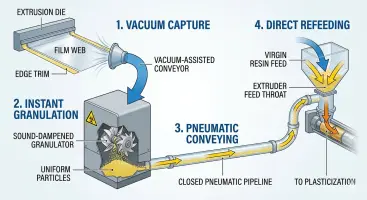
Achieving Zero-Waste Production: How Stretch Film Extrusion Machine with Online Edge Trim Recycling Saves Raw Material Costs?
Modern stretch film extrusion lines integrate continuous inline edge trim recycling systems to eliminate post-industrial waste. By instantly crushing and refeeding sticky LLDPE trim back into the extruder feed throat, this closed-loop process retains virgin polymer physical properties, heavily reducing raw material costs and maximizing sustainable plant profitability.
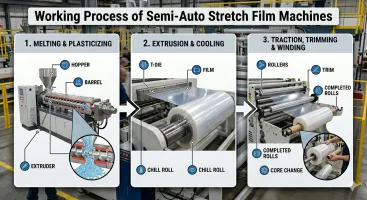
Working Process of a Semi-Auto Stretch Film Extrusion Machine
The process begins as LLDPE resins are melted and plasticized through a high-precision extruder. The molten material is fused in a T-die and instantly cooled by a chill roll to ensure clarity. After automatic traction and trimming, operators manually change paper cores at the winding station to complete the rolls.
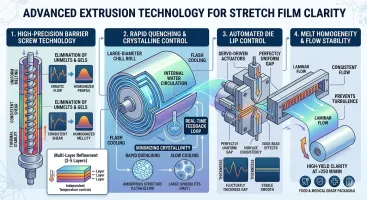
How Stretch Film Extrusion Machine Improve Film Transparency
In today’s high-stakes packaging market, film transparency is no longer cosmetic—it is a direct indicator of polymer purity, process stability, and end-product value. Traditional stretch film extrusion often produces haze due to...
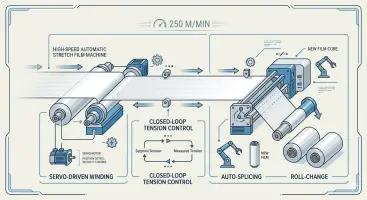
Maximizing Output: Analyzing the 250m/min High-Speed Stretch Film Extrusion Machine
In the high-stakes world of industrial packaging, production bottlenecks often arise when output cannot keep pace with demand. Achieving a consistent 250 m/min extrusion line speed...
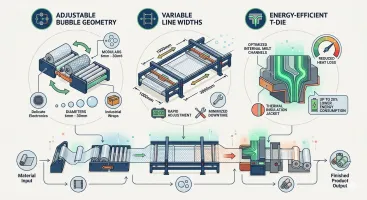
Customizing an Extrusion Machine to Fit Your Specific Production Needs
Explore technical customization of air bubble film extrusion machines, focusing on multi-layer co-extrusion (2-7 layers), adjustable bubble diameters (6-30mm), and variable line widths (1000-3000mm). Highlight tailored features like PLC smart controls, energy-efficient T-die designs, and online lamination for aluminum foil or EPE foam, optimizing production efficiency and specialized packaging performance.
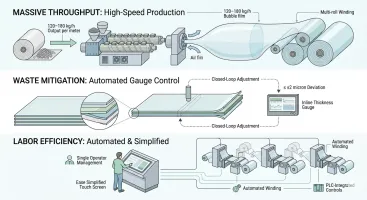
ROI Analysis of Bubble Film Extrusion Machine Investment
Modern bubble film extrusion machines with servo drives, optimized heating, and automated thickness control cut energy use by 15–30%, improve film consistency, shorten payback periods, and enhance ROI for packaging manufacturers.
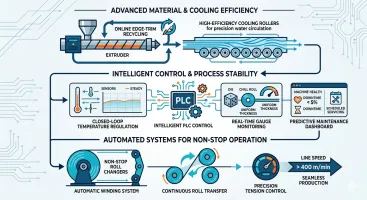
How Stretch Film Extrusion Machine Support 24/7 Production
Modern stretch film extrusion machines are engineered for continuous 24/7 production through automated winding systems, non-stop roll changing, intelligent PLC control, and servo-driven tension regulation. Advanced cooling rolle