
News
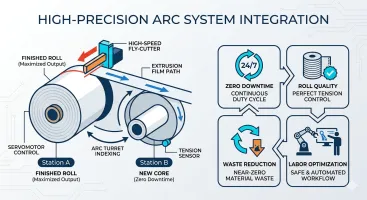
Analysis of the Advantages of Automatic Roll Change in Modern Stretch Film Extrusion Machine
In the fast-paced world of industrial packaging, any production stoppage is a direct hit to the bottom line. For manufacturers of stretch film using high-capacity extrusion lines, the tradit...
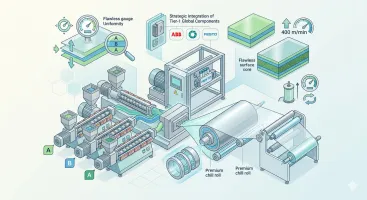
Why It Is Safe to Source Stretch Film Extrusion Machines Directly from Chinese Manufacturers
For decades, the global packaging industry has viewed offshore procurement of capital equipment with understandable caution. However, the structural evolution of China’s vertical supply chain for stretch film extrusion machinery—spanning Semi-Automa…
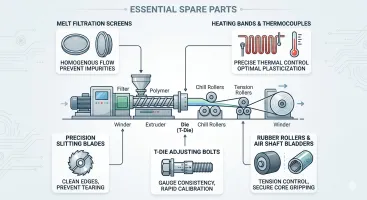
Essential Spare Parts You Should Always Have for Your Stretch Film Extrusion Machine
To ensure seamless production, maintaining a stock of high-wear Stretch Film Extrusion Machine components is vital. Essential consumables include filter screens for melt filtration, heating bands for thermal stability, and precision slitting blades. Critical mechanical spares like rubber rollers, thermocouples, and air shaft bladders are indispensable for minimizing downtime and ensuring consistent film tension.
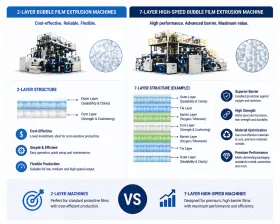
Sizing Your Production: Should You Get a 2-Layer or 7-Layer Bubble Film Extrusion Machine?
Facing production bottlenecks or market pressure for higher-quality protective packaging? Choosing the right bubble film extrusion machine is critical. This analysis compares 2-layer and 7-layer ...
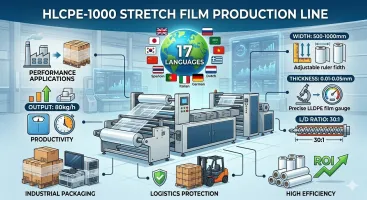
Semi-Automatic Stretch Film Extrusion Machine: Performance & Industrial Applications
In the high-stakes world of logistics and manufacturing, inconsistent hand-wrapping and inefficient film usage are not just operational hiccups—they are costly bottlenecks that compromise supply chain integrity and profitability. Businesses seeking ...
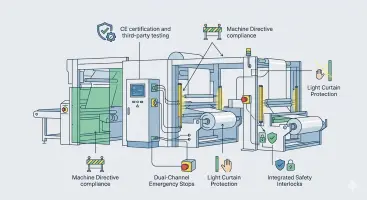
CE Certified China Stretch Film Machine for European Market Standards
Engineered for strict European directives, this high-performance stretch film machine features mandatory CE compliance, incorporating integrated safety interlocks and emergency stop systems. Equipped with advanced PLC automation and precise German servo drives, it ensures optimal LLDPE multi-layer co-extrusion control, delivering consistent gauge uniformity, superior film elongation, and reliable, high-speed energy-efficient operation.
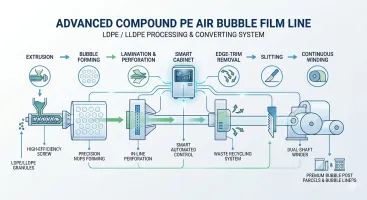
Labor-Saving Automation in Modern Bubble Film Extrusion Machine
As e-commerce logistics demand surges, manufacturers face critical labor shortages and efficiency bottlenecks. This article explores how advanced compound polyethylene air
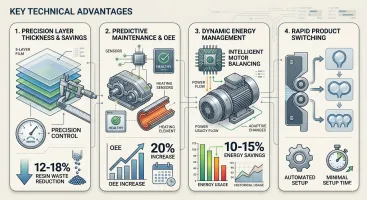
Why Factories are Shifting to Intelligent Bubble Film Extrusion Machine
Factories are adopting intelligent bubble film extrusion machines for automated monitoring, adaptive process control, and predictive maintenance. These systems reduce material waste, enhance energy eff...
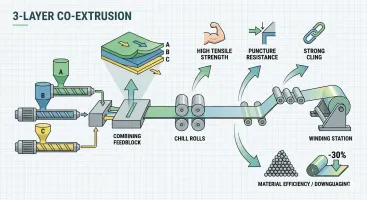
Advantages of 3-Layer Stretch Film Extrusion Machine
For years, purchasing managers and operations directors in the packaging sector have grappled with a persistent trade-off: achieving the necessary load stability for palletized goods without...
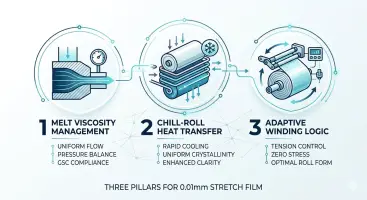
Guide to Consistent Production of 0.01mm Ultra-Thin Stretch Film
Achieving consistent 0.01mm ultra-thin stretch film production requires precise co-extrusion control and premium LLDPE resins. Maintaining uniform melt viscosity through rigorous temperature ma...