
Technical Encyclopedia
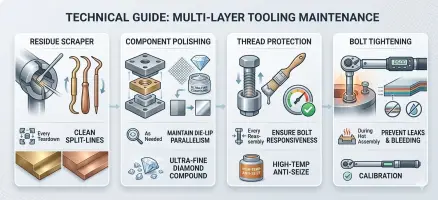
How to Clean and Maintain a T-Die for Stretch Film Making Machine
Proper T-die cleaning is vital for stretch film thickness uniformity and surface quality. This guide covers hot disassembly, brass tools, lip polishing, and torque calibration to minimize defects and downtime.
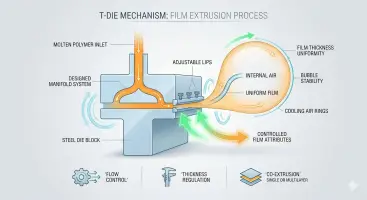
Decoding the T-Die Mechanism in Bubble Film Making Machine
The T-die in bubble film extrusion controls molten polymer flow, ensuring uniform film thickness and bubble formation. Its adjustable lips, combined with precise temperature and pressure regulation, prevent gauge variations and defects. Optimized T-die design enhances bubble stability, mechanical strength, and co-extrusion efficiency in single- or multilayer film production.

Technical Parameters: Stability of 23000KG Heavy Duty Bubble Film Making Machine
Industrial-scale bubble film production demands unyielding stability. Our 23000KG heavy-duty extrusion system, engineered with a rigid steel chassis and precision-balanced rollers, eliminates gauge variation and vibration for flawless uniform bubble formatio

Bubble Film Making Machine Plasticization: 34:1 L/D Ratio Advantages
Unlock higher output speeds and exceptional bubble stability with our 34:1 L/D ratio plasticization system. This advanced technology extends polymer residence time, ensuring thorough melting and uniform plasti
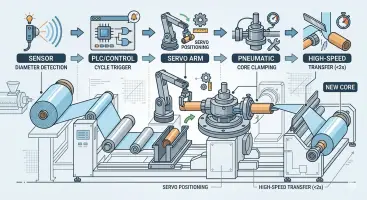
Automatic Core Changer for Stretch Film Making Machine: How It Works
The Automatic Core Changer revolutionizes stretch film production by replacing cores without stopping the line. Integrating sensors, pneumatic actuators, and servo-driven mechanisms, it eliminates downtime, maintains consistent tension, and enhances safety. This technology is critical for 2-layer, 3-layer, and 5-layer stretch film machines, delivering unmatched production efficiency and profitability.
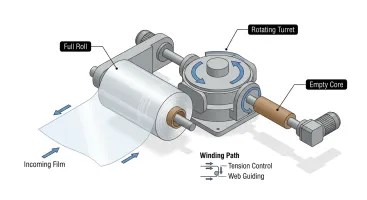
How Automatic Winding Systems Maximize Efficiency in 2-Layer Stretch Film Lines
Explore how dual-station turret winders with precision PLC control eliminate downtime, ensure zero material waste, and deliver consistently tight rolls for superior productivity and ROI in industrial stretch film manufacturing...
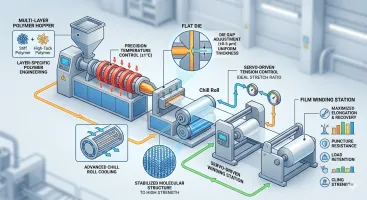
The Core Role of PLC Control Systems in Stretch Film Manufacturing Machine
PLC systems act as the central intelligence of stretch film manufacturing machines, ensuring high-precision automation through real-time monitoring. By regulating extruder temperatures, synchronizing motor speeds, and mana
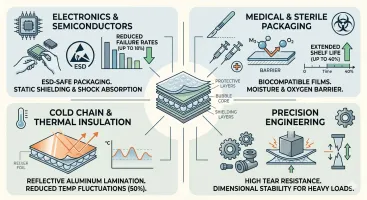
Application Scenarios of High Speed Air Bubble Film Machine
Modern High Speed Air Bubble Film Machines drive efficiency in protective packaging, using multi-layer co-extrusion for electronics, medical devices, and precision instruments. These systems deliver shock absorption, thermal insulation, and anti-static solutions, enhancing ROI for global manufacturers...
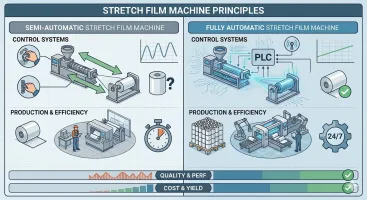
Automatic vs. Semi-Automatic Stretch Film Making Machine: What’s the Difference?
This guide compares automatic and semi-automatic stretch film making machines in industrial applications. Learn how extrusion control, winding precision, and throughput differ, and why automation delivers higher ROI for high-volume manufacturers responding to global sourcing demands...
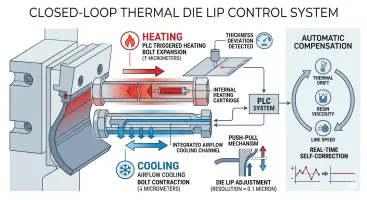
Principles of Thermal Expansion Bolts in Automatic Die Heads
In the high-stakes world of B2B industrial film production, even micron-level inconsistencies in die gaps can lead to catastrophic material waste and downtime. Traditional manual die adjustment methods are slow, inaccurate, and rely heavily on operator expertise. Our patented Thermal Expansion Bolt (TEB) technology revolutionizes automatic die heads for 2-layer high-speed bubble film machines, 7-layer high-speed bubble film lines, and 3-5 layer medium-speed film extruders. By integrating internal heating cartridges and forced-air cooling, these actuators induce precise longitudinal elongation, dynamically regulating die lip openings with closed-loop feedback. This automated system eliminates manual tuning, delivering uniform film thickness across entire production runs. The result: a 15-20% reduction in material waste, faster start-up cycles, and consistent product quality that exceeds global packaging standards. For procurement managers evaluating 2-layer stretch film machines or 5-layer high-speed bubble film lines, this technology offers a clear competitive advantage in operational efficiency and total cost of ownership...